


Where this post comes from: A news article about a large foreign investor putting money into an Indian company sparked this idea about bulk and block deals data. The investor is used only as an example. The author does not follow this firm, and nothing here is a view on any stock.
Bulk and block deals data is a free way to see what big investors are doing. Every now and then, a headline tells you that a big investor has put a lot of money into an Indian company. On 29 September 2026, for example, Canada Pension Plan Investment Board (CPP Investments) announced an investment in an unlisted Indian company. Since the company is unlisted, you cannot buy its shares on an exchange. But the news raises a useful mquestion.
How do we find big deals like this in listed companies? One good answer is bulk and block deals data, which both Indian stock exchanges publish for free. It is a good way to track what big investors are doing.
What are bulk and block deals?
Let us start with the basics.
A bulk deal is a trade where the total shares bought or sold in a day is more than 0.5% of a company’s listed shares. It happens on the normal trading screen, like any other trade. The exchange then shares the details with the public after market hours on the same day.
A block deal is one very large trade, done through a special trading window that is separate from the normal market. SEBI, the market regulator, sets the rules for block deals, such as the minimum size, and has revised them over time. So check the latest exchange notices for the current limits. Like bulk deals, the exchanges publish the details after market hours on the same day.
In short, both are “big trades made public.” The details that matter to us are who traded, which company, how many shares and at what price.
Where to find bulk and block deals data
Both exchanges offer this data on their websites, and you can download it for a period you choose.
NSE: Bulk and block deals page
BSE: Bulk and block deals page
You pick the deal type, set the From and To dates, and submit. NSE lets you download the result as a CSV file. A CSV is a plain text file with values separated by commas, which opens in Excel.
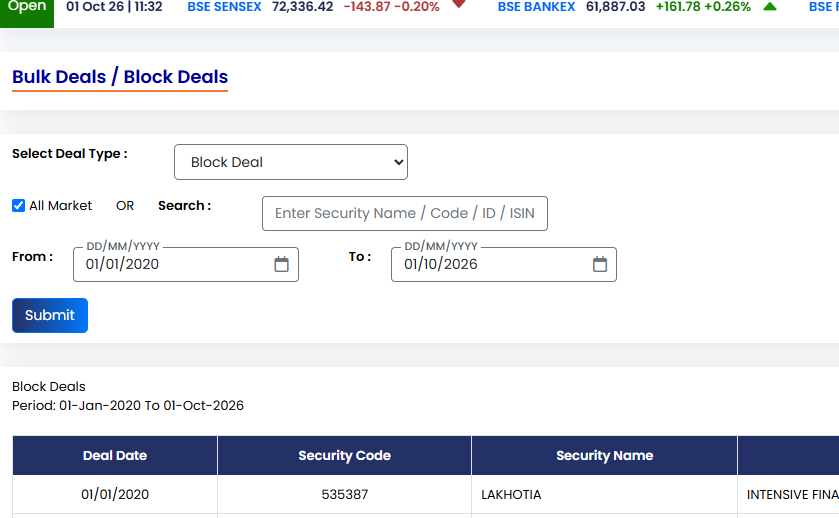
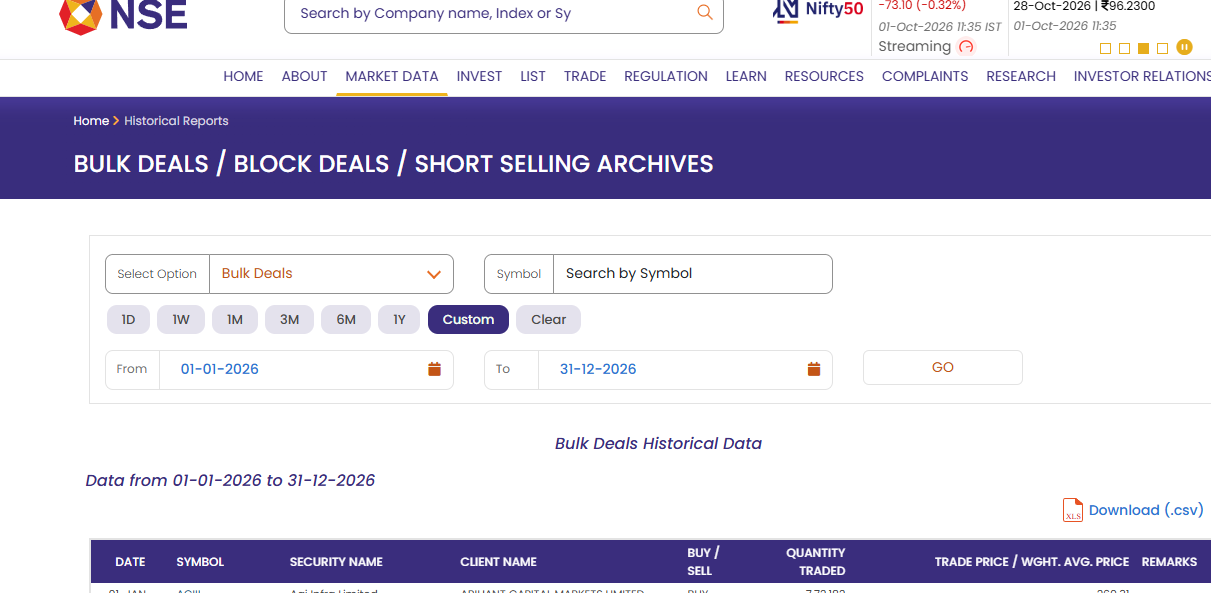
I downloaded the data from 2020 to date from both exchanges and processed it myself.
Bulk and block deals data: NSE and BSE look different
The two files do not look alike, so you cannot simply stack them together.
BSE columns: Deal Date, Security Code, Company, Client Name, Deal Type, Quantity, Price. The deal type is P for purchase and S for sale.
NSE columns: Date, Symbol, Security Name, Client Name, Buy / Sell, Quantity Traded, Trade Price / Wght. Avg. Price, Remarks. Here the deal type is spelled BUY or SELL.
Even the company column has a different name: “Company” on BSE and “Security Name” on NSE. This is the format today and it may change later. The good news is that every row has a client name and a security code or symbol, so you can match records across both files.
If matching the same stock across the two exchanges is new to you, my earlier article on how UDiFF and ISIN make NSE vs BSE comparison easy covers another free exchange dataset, the bhavcopy (the daily price file), and the same idea of lining up two different formats.
Track big investors by name: the CPP example
Suppose you want to see what an investor like CPP Investments did in the market. You can search the client name column. Here is what my processed data showed:
BSE: Searching “cpp” found nothing. But searching “Canada pension” found 19 trades under Canada Pension Plan Investment Board.

NSE: Searching “cpp” found 1 trade under CPP Investment Board Private Holdings (4) Inc. Searching “Canada” found 3 trades under Canada Pension Plan Investment Board.


So the same investor can appear under different names, and a search on a short name can miss it entirely. I am not saying these entities are the same. That is for you to check. These are just the entries found in the files.
Why a name search needs care
A few habits help when you track investors by name.
1. Search more than one spelling. Try the short form, the full name, and keywords such as “Canada” or “pension”.
2. Look at both exchanges. The same investor may show up on one and not the other.
3. Do your due diligence. Different names may be different arms of one group, or they may be unrelated. Confirm using annual reports, shareholding patterns or filings before you draw a conclusion.
What bulk and block deals data cannot tell you
This is only one piece of the puzzle. It covers trades that crossed the bulk and block thresholds on the exchanges. Deals struck privately between two parties, such as a direct investment into an unlisted company, do not pass through the exchange trading screen. So they do not appear in this data. There can be other deals outside it that are simply not captured.
It is our duty to figure out what is what, and to take this data with a pinch of salt. It shows one angle, not the whole picture.
Why it is a treasure
If you analyze markets, bulk and block deals data shows you where large money moved, who moved it and at what price, across thousands of companies, for free. You can ask questions like: which investors keep buying the same company? Who sold heavily before or after big news? Which stocks see repeated large deals?
It will not give you answers by itself. It gives you leads. You still have to do the work. But it is freely available, and many people never use it. This article is meant to point you to it.
This article is for information only and is not investment advice or a recommendation on any stock. Names, figures and exchange rules may change. Any mistakes in summarizing are the author’s.
Key takeaways
- What it is: Bulk and block deals data is a free record of large trades, and both NSE and BSE publish the details after market hours on the same day.
- How to use it: Download the data from the NSE and BSE websites, then search the client name column. Try more than one spelling and check both exchanges, because the same investor can appear under different names.
- What it cannot show: Private deals, such as a direct investment into an unlisted company, do not appear in this data. It gives you leads, not the whole picture.
Frequently asked questions
A bulk deal is a trade where the total shares bought or sold in a day is more than 0.5% of a company’s listed shares, and it happens on the normal trading screen. A block deal is one very large trade done through a special trading window that is separate from the normal market. In both cases the exchanges publish the details after market hours on the same day.
Both NSE and BSE publish it on their websites for free. You pick the deal type, set the From and To dates, and submit. NSE lets you download the result as a CSV file, which opens in Excel.
Search the client name column and try more than one spelling, such as the short form, the full name and keywords like ‘Canada’ or ‘pension’. Check both exchanges, because the same investor can appear under different names. Then confirm using annual reports, shareholding patterns or filings before you draw a conclusion.
It covers only trades that crossed the bulk and block thresholds on the exchanges. Deals struck privately between two parties, such as a direct investment into an unlisted company, do not pass through the exchange trading screen, so they do not appear in this data.
Sources
Main sources
Exchange pages: NSE bulk and block deals and BSE bulk and block deals
Author’s own processed NSE and BSE downloads, 2020 to date (the CPP name counts)
Other sources
SEBI Master Circular, Chapter 1: Trading (bulk deals)
SEBI circular, Review of Block Deal Framework, 8 October 2025 (copy hosted by Medianama)
AXCZEL Insights: One Format, Two Exchanges: How UDiFF and ISIN Make NSE vs BSE Comparison Easy
I used Claude, an AI assistant, to rephrase my notes to make it reader friendly.