

Where this post comes from: This article is built around notes and charts prepared by the author from the Reserve Bank of India’s official publication and press release on the Supervisory Data Quality Index (sDQI). We independently verified the key figures against the RBI’s own release and publication page before writing this up. We did not read any third-party research report on this topic — the RBI’s own numbers are the source.
Every three months, India’s scheduled commercial banks send the Reserve Bank of India (RBI) a mountain of paperwork — numbers on their loans, deposits, capital, liquidity and more. This is how the regulator keeps an eye on whether banks are healthy. But there’s a catch: that oversight is only as good as the data banks report. If the numbers are wrong, late or incomplete, the RBI’s ability to spot trouble early is weakened.
To keep banks honest and on time, the RBI scores them on exactly this — and on 22 September 2026, it released the latest scorecard. The news is good: banks’ reporting quality has jumped to its highest level yet.
What is the Supervisory Data Quality Index (sDQI)?
The Supervisory Data Quality Index, or sDQI, is a score the RBI gives to banks based on how well they report their regulatory data — the returns and detailed records banks are required to file for supervision. Think of it as a report card, but instead of grading a student’s homework, it grades a bank’s paperwork.
The RBI checks this paperwork on four things:
Accuracy — are the numbers correct?
Completeness — is anything missing?
Timeliness — was it submitted on time?
Consistency — do the numbers match up with what the bank has reported elsewhere?
Each bank gets a composite score out of 100, and the RBI sorts these scores into four bands:
Above 90 — Good
80 to 90 — Acceptable
70 to 80 — Needs improvement
Below 70 — Major concerns
The whole exercise checks whether banks are following the rules laid out in the RBI’s Supervisory Returns Directions — the formal rulebook that spells out what banks must report, and how accurately and promptly. The sDQI is published quarterly on the RBI’s website.
What the June 2026 numbers show
The latest release covers the quarter ended June 2026, and looks at 87 scheduled commercial banks.
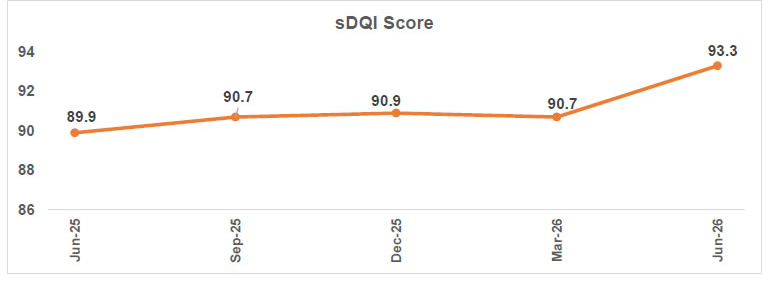
The headline number improved sharply. The overall sDQI for these banks rose to 93.3, up from 90.7 in March 2026 — comfortably inside the “Good” band, and the strongest reading in the five quarters the RBI has been tracking (the score has moved from 89.9 in June 2025, to 90.7, 90.9, 90.7, and now 93.3).
Accuracy did the heavy lifting. Of the four parameters, accuracy saw by far the biggest jump — from 86.8 to 96.3, a gain of 9.5 points. Completeness also edged up (96.4 to 96.9) and timeliness improved (92.1 to 92.8), while consistency dipped only marginally (87.4 to 87.3). In plain terms: banks got noticeably better at reporting correct numbers, which is what pulled the overall score up.
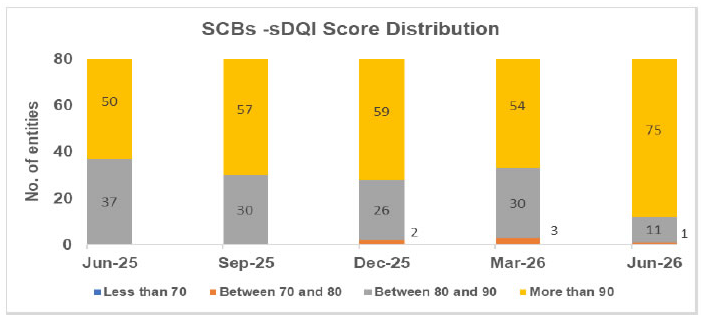
More banks are firmly in the “Good” zone. Out of the 87 banks assessed, 75 scored above 90 in June 2026 — up from 54 just one quarter earlier. Only 11 banks fell in the “Acceptable” band (80–90), just one bank scored in the “Needs improvement” range (70–80), and, importantly, not a single bank scored below 70.
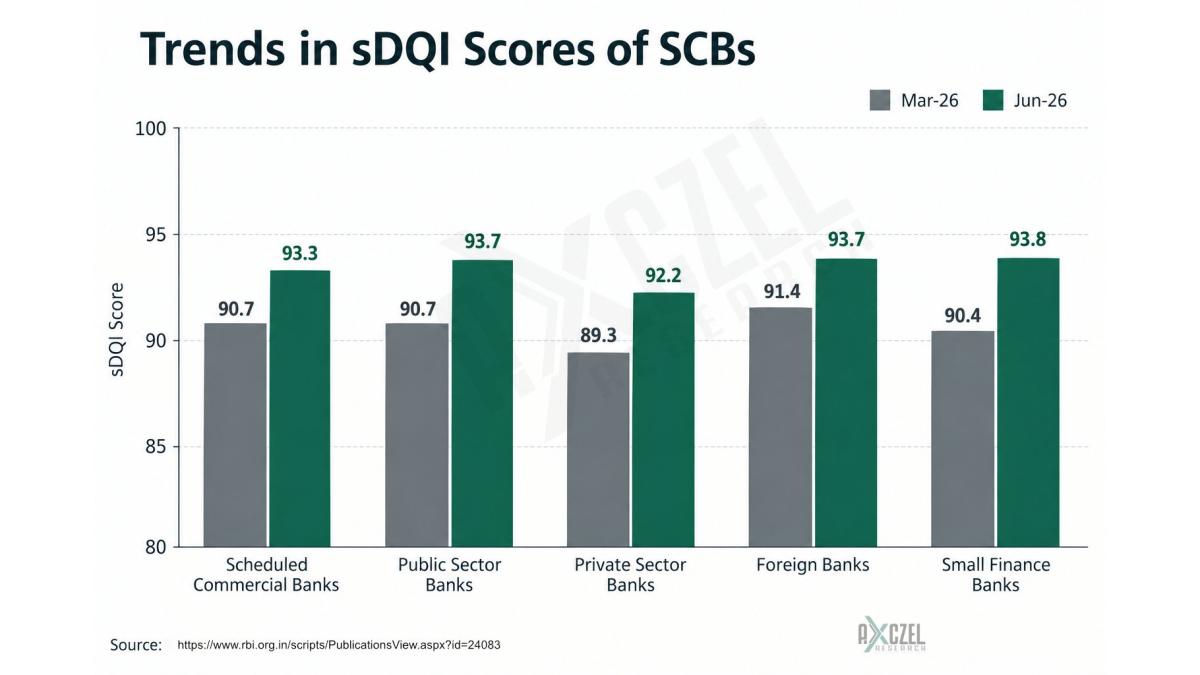
Smaller banks led the pack. Broken down by category, Small Finance Banks posted the highest score at 93.8 (up from 90.4 in March), narrowly ahead of Public Sector Banks and Foreign Banks, both at 93.7 (up from 90.7 and 91.4 respectively). Private Sector Banks improved too, from 89.3 to 92.2, though they remain the relative laggard among the four groups — all comfortably inside the “Good” band regardless.
What it means for the common man
It’s easy to read a story about a “data quality index” and move on — it sounds like something only regulators and bank auditors should care about. But it isn’t. Here’s why it matters even if you’ve never filled out a supervisory return in your life.
It’s an early-warning system for your deposits. The RBI relies on the numbers banks report to spot trouble — a bank piling up bad loans, running low on capital, or facing a liquidity crunch — before it becomes a crisis. That early warning only works if the underlying data is accurate and on time. When banks report sloppily, red flags can go unnoticed for longer. A rising sDQI means the RBI is getting a clearer, faster picture of every bank’s health, which means problems are more likely to be caught while they’re still small and fixable — before they ever reach the point of threatening depositors’ money.
It’s a rough proxy for how seriously a bank takes discipline. A bank that is careful, timely and consistent in the numbers it hands the regulator is, generally speaking, also a bank with better internal systems and controls. That kind of discipline tends to show up elsewhere too — in how carefully it manages risk day to day. Data quality alone won’t tell you if a bank is safe, but a bank that habitually reports poor-quality data is one worth watching.
It supports a more transparent banking system overall. Zero banks scoring below 70, and only one below 80, out of 87 banks, is a meaningfully healthier picture than earlier quarters. For an everyday customer, that translates into a banking sector that is, on the whole, more transparent with its regulator — and a regulator that is better equipped to act on real problems rather than being kept in the dark by bad reporting.
To be clear: the sDQI measures the quality of a bank’s *reporting*, not directly the quality of a bank’s *balance sheet*. A bank can report accurately and still have real financial problems — this index doesn’t measure that. What it does tell you is whether the regulator is getting an honest, timely picture to work with, which is the necessary first step to catching problems at all.
This article is for general information only and should not be treated as investment or financial advice. Figures are based on the RBI’s official release dated 22 September 2026 and may be revised or restated in future publications. Every effort has been made to summarize this data accurately, but any errors in interpretation are the author’s own.
Key takeaways
- The result: On 22 September 2026, the RBI released the Supervisory Data Quality Index (sDQI) for the quarter ended June 2026, covering 87 scheduled commercial banks. The overall score rose to 93.3 from 90.7 in March 2026, the highest in the five quarters tracked and inside the “Good” band (above 90).
- What drove it: Accuracy rose from 86.8 to 96.3. In all, 75 of the 87 banks scored above 90, up from 54 a quarter earlier, 11 were in the Acceptable band, one needed improvement and none scored below 70.
- What it does not show: The sDQI measures the quality of a bank’s reporting, not directly the quality of its balance sheet. A bank can report accurately and still have real financial problems.
Frequently asked questions
The sDQI is a score the RBI gives banks based on how well they report their regulatory data, meaning the returns and detailed records banks must file for supervision. The RBI checks accuracy, completeness, timeliness and consistency. Each bank gets a composite score out of 100, and the index is published quarterly on the RBI’s website.
The RBI sorts the scores into four bands: above 90 is Good, 80 to 90 is Acceptable, 70 to 80 is Needs improvement, and below 70 is Major concerns.
The overall score for 87 scheduled commercial banks rose to 93.3 from 90.7 in March 2026, the strongest reading in the five quarters tracked. Accuracy rose from 86.8 to 96.3. In all, 75 banks scored above 90, up from 54 a quarter earlier, and no bank scored below 70. By category, Small Finance Banks scored 93.8, Public Sector Banks and Foreign Banks 93.7 each, and Private Sector Banks 92.2.
The RBI relies on the numbers banks report to spot trouble, such as bad loans, low capital or a liquidity crunch, before it becomes a crisis. That early warning only works if the data is accurate and on time. A rising sDQI suggests the RBI is getting a clearer, faster picture of each bank’s health, though the index does not measure the quality of a bank’s balance sheet.
Sources
Main sources
Reserve Bank of India, Press Release: Supervisory Data Quality Index (sDQI) for SCBs – June 2026
Reserve Bank of India, Supervisory Data Quality Index (sDQI) for Scheduled Commercial Banks – June 2026 (full publication)
Other sources
The Tribune, Indian banks’ regulatory data quality improves as RBI’s Supervisory Data Quality Index rises to 93.3 in June Quarter
This article was written with the help of Claude, an AI assistant, used to rephrase and present the author’s notes in a reader-friendly manner.