

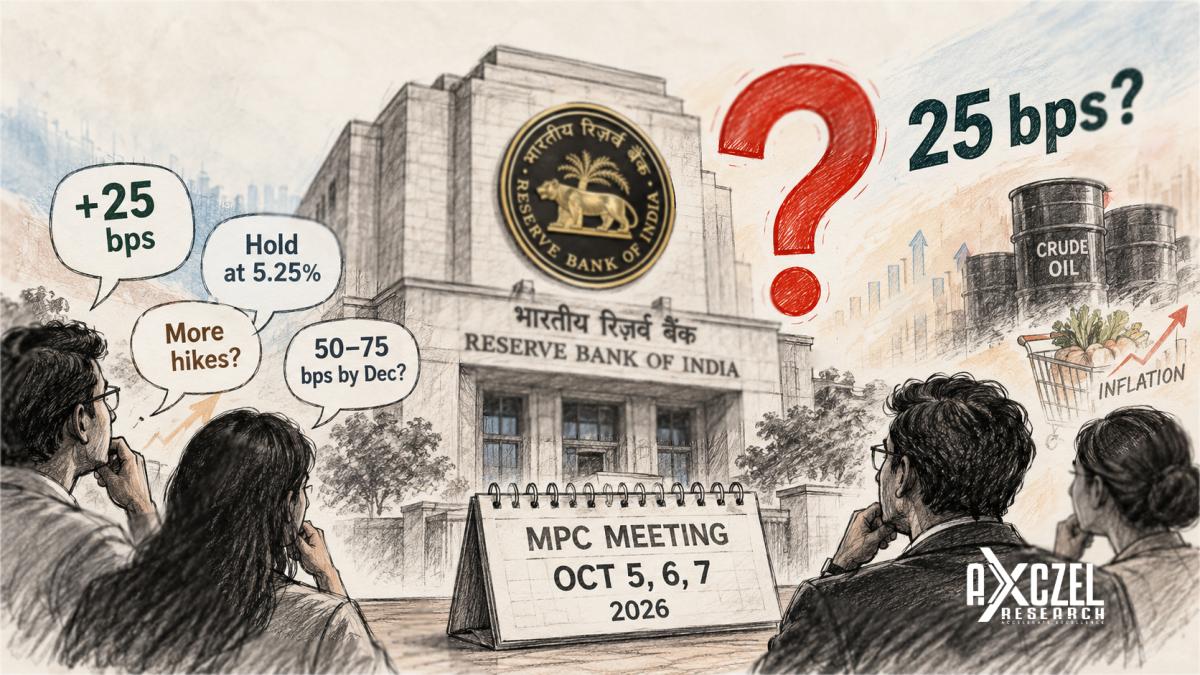
This article rounds up what a Reuters poll of economists, and analysts at banks like Nomura, are expecting from the RBI’s October policy meeting, including whether an RBI rate hike (a repo rate increase) is coming. These are their predictions, not ours — we are only summarising, not forecasting. Every figure below links to the report it came from, so you can check the original yourself.
The Reserve Bank of India’s rate-setting panel, called the Monetary Policy Committee (MPC), meets from October 5 to 7, 2026 — and a growing number of economists are now expecting an RBI rate hike at this meeting. This is the meeting where the RBI decides whether to change the repo rate — the interest rate at which the RBI lends money to banks, which in turn influences the interest rates banks charge you on loans and pay you on deposits.
For most of 2026 so far, the RBI has kept this rate unchanged at 5.25%, including at its last meeting in August. But going into October, a growing number of economists think an RBI rate hike is about to happen. Here is a plain-English summary of what different sources are saying, and why.
Why Inflation Is Pushing the RBI Toward a Rate Hike
Before getting to the predictions, it helps to understand what’s pushing inflation up.
India’s retail inflation (measured by the Consumer Price Index, or CPI) rose to 4.82% in August 2026, up from 4.45% in July. Food inflation — the price rise for items like vegetables, pulses and grains — climbed further, to 5.95% in August. This is the highest inflation reading of the year so far, and it has been rising for several months in a row.
A big part of the reason is oil. Global crude oil prices have been elevated for most of 2026 because of the conflict between Iran and a US-Israel coalition, which disrupted shipping through the Strait of Hormuz — a narrow sea route that carries a large share of the world’s oil trade. Brent crude, the international oil benchmark, spiked as high as around $118 a barrel in March 2026, cooled off in the middle of the year, and has climbed back toward the $100-105 a barrel range through September, partly due to fresh incidents like drone damage to a pipeline in Saudi Arabia. Since India imports roughly 85% of the crude oil it uses, costlier oil pushes up transport and fuel costs across the economy, which then shows up in the inflation numbers.
At its August meeting, the RBI held rates steady but flagged a risk: if inflation pressures broadened out beyond food and fuel into other parts of the economy, it would need to act. Several economists now believe that is exactly what is happening.
The Reuters Poll: Why Economists Expect an RBI Rate Hike
A Reuters poll of 61 economists, published on September 28, found that a majority — 35 of the 61 — expect the RBI to raise the repo rate by 25 basis points (0.25 percentage points) to 5.50% at the October meeting. If that happens, it would be the RBI’s first rate hike since February 2023.
The poll also found a slim majority (29 of 53 economists who answered that question) expect at least one more 25 basis point hike by the December policy meeting, which would take the repo rate to 5.75%. (Source: Reuters)
The reasons economists gave for expecting a hike include:
Inflation has broadened: prices in nearly half of the items in India’s inflation basket are now rising at 4% or more per year, up from about a third of items back in March.
The rupee has weakened by roughly 6% against the US dollar this year, and a rate hike is one tool the RBI can use to make Indian assets more attractive to foreign investors, which can help support the currency. (We’ve separately covered another tool the RBI leans on to defend the rupee, in our explainer on FCNR deposits and why the RBI wants NRIs’ dollars.)
The economy remains strong, which gives the RBI room to raise rates without worrying too much about slowing growth — India’s GDP grew nearly 8% in the April-June quarter, and bank lending grew by more than 19% in July.
Nomura’s RBI Rate Hike Call for October and December
The global brokerage Nomura, in a note from economists Sonal Verma and Aurodeep Nandi, has also moved to expecting back-to-back hikes: 25 basis points in October and another 25 basis points in December, taking the repo rate to 5.75% by the end of the year — broadly in line with the more hawkish end of the Reuters poll.
Nomura’s reasoning is a little different from a simple “inflation is high, so hike” story. The brokerage says India’s underlying, or “core,” inflation has actually been coming down (from around 5% to around 3%), and its own measure of how broadly price pressures are spreading across the economy shows limited signs of a widespread problem. In other words, Nomura sees this mainly as a food-and-oil price shock rather than a sign of overheating demand. (Source: Business Standard, on Nomura’s research)
Because of that, Nomura thinks the market may be overpricing how aggressive the RBI will be. It noted that interest rate markets were pricing in nearly 125 basis points of hikes over the next year — a full percentage point of rate increases — which Nomura considers excessive. Its own base case is a more modest “recalibration” of 25-50 basis points, not the start of a long hiking cycle. It expects headline inflation to peak around 6.3% in the October-November period before easing back below 4% by the second half of 2027.
Other RBI Rate Hike Estimates: A Wider Range
Not everyone is pinned to exactly 50 basis points by December. Some commentary — including a report in Deccan Chronicle — pointed to a broader range of 50-75 basis points of combined hikes across the October and December meetings, with a few economists flagging a risk of 75-100 basis points if oil prices stay elevated for longer. Most of these estimates, though, describe the likely hiking cycle as “shallow” rather than aggressive — a couple of moves to bring rates back up, not a long series of increases.
A quick correction on the numbers: one report we reviewed cited August food inflation at 5.66%. Multiple other outlets, citing the same official data release, put the figure at 5.95%. We’ve used 5.95% in this article, since it is the figure more widely reported.
The Global Backdrop: the Fed Hiked Too
It isn’t only the RBI facing this pressure. On September 16, 2026, the US Federal Reserve raised its own interest rate by 25 basis points — its first hike in three years — in the very first policy decision under its new chair, Kevin Warsh. Notably, this happened despite US President Donald Trump publicly and repeatedly calling for lower rates. It’s a reminder that central banks in several countries are currently dealing with the same problem: inflation that has picked up largely because of energy and food prices, even as political pressure pushes the other way.
What an RBI Rate Hike Would Actually Mean for You
If the RBI does raise the repo rate, it typically becomes more expensive to borrow. Home loans, car loans and other loans linked to external benchmarks (most floating-rate retail loans in India are) tend to see their interest rates go up within a few weeks to months, which raises EMIs (equated monthly instalments) for existing borrowers, or extends how long you’re paying, depending on your bank’s approach. On the flip side, fixed deposit rates usually inch up too, which is good news for savers.
A 25 basis point move is a modest one — for context, that is a change of just 0.25 percentage points, so on a typical home loan it usually translates to a relatively small increase in monthly EMI. But if the RBI does go ahead with two hikes, as several of the sources above expect, the cumulative effect (0.50 percentage points) is more noticeable. (If you want to see how this connects to global bond markets, we’ve also covered why rising US bond yields are bad news for Indian stocks.)
The Bottom Line on an RBI Rate Hike and the Repo Rate
Nobody — not the economists polled by Reuters, not Nomura, and certainly not us — knows for certain what the RBI’s MPC will decide on October 7. But going by what’s been published so far, a 25 basis point RBI rate hike in October looks like the more widely expected outcome, with many of the same sources also expecting a further hike in December. The main driver cited across the board is the same: an oil-and-food-price shock, tied largely to the ongoing disruption from the Iran conflict, that has pushed inflation to its highest level this year.
This article is for general information only and is not investment or financial advice. It summarises predictions published by third parties as of late September 2026; these are forecasts, not certainties, and the actual RBI decision may differ. Figures such as inflation data and oil prices can be revised or may have moved by the time you’re reading this. Any errors in summarising the original sources are the author’s own.
Key takeaways
- What is expected: In a Reuters poll of 61 economists published on 28 September 2026, 35 expect the RBI to raise the repo rate by 25 basis points to 5.50% at its 5 to 7 October meeting. These are the economists’ predictions, not an Axczel forecast.
- Why they expect it: Retail inflation rose to 4.82% in August 2026, from 4.45% in July, and food inflation climbed to 5.95%, largely because of elevated oil prices. Economists also cited broadening inflation and a rupee that has weakened by roughly 6% against the dollar this year.
- The range of views: Nomura expects 25 basis points in October and another 25 in December, taking the repo rate to 5.75%. It also calls its base case a modest “recalibration” of 25 to 50 basis points and thinks markets pricing in nearly 125 basis points are excessive. The actual decision on 7 October may differ.
Frequently asked questions
The repo rate is the interest rate at which the RBI lends money to banks. It influences the interest rates banks charge you on loans and pay you on deposits. The RBI has kept it unchanged at 5.25% for most of 2026, including at its August meeting.
A Reuters poll of 61 economists, published on 28 September 2026, found that 35 expect a 25 basis point hike to 5.50% at the October meeting. That would be the RBI’s first hike since February 2023. Of 53 economists who answered, 29 expect at least one more 25 basis point hike by December, taking the rate to 5.75%. These are published predictions, not certainties.
The reasons they gave are that inflation has broadened, with prices in nearly half of the items in India’s inflation basket rising at 4% or more a year, up from about a third in March; that the rupee has weakened by roughly 6% against the dollar this year; and that the economy remains strong, with GDP growth of nearly 8% in April to June. Higher oil prices tied to the Iran conflict are the main driver of the inflation rise.
If the RBI raises the repo rate, borrowing typically becomes more expensive. Rates on loans linked to external benchmarks, as most floating-rate retail loans in India are, tend to rise within a few weeks to months, which raises EMIs or extends how long you pay. Fixed deposit rates usually inch up too. A 25 basis point move is a change of 0.25 percentage points, which usually means a relatively small increase in a typical home loan EMI.
Sources
Main sources
RBI to Raise Rates to 5.50% in October, Inflation Broadens: Reuters Poll — Reuters, Sep 28, 2026
RBI May Hike Repo Rate by 25 bps Each in October and December — Business Standard, Sep 15, 2026 (Nomura’s initial view)
“Excessive” 125bps Rate Hike Over the Next Year: Nomura, Says Markets Pricing — Business Standard, Sep 28, 2026
RBI Seen Raising Repo Rate by 25 Basis Points in October Policy Meet — Deccan Chronicle
Other sources
RBI MPC Keeps Repo Rate Unchanged at 5.25% — Business Standard, Aug 2026
Retail Inflation Rises to 4.82% in August as Food Inflation Climbs to 5.95% — Business Standard
India’s Retail Inflation at 4.45% in July 2026; Food Inflation at 5.52% — Business Standard
India Inflation Ticks Up to 4.82% in August as Fuel Shocks Bite — Briefs
2026 Iran War Fuel Crisis — Wikipedia
Crude Oil Price Today — Forbes Advisor, Sep 25, 2026
Fed Rate Decision September 2026: Rates Rise to 3.75%-4% — CNBC
The Fed’s Unanimous 25-Basis-Point Hike Puts Trump and Warsh on Collision Course — Bloomberg
I used Claude, an AI assistant, to rephrase my notes to make it reader friendly.