

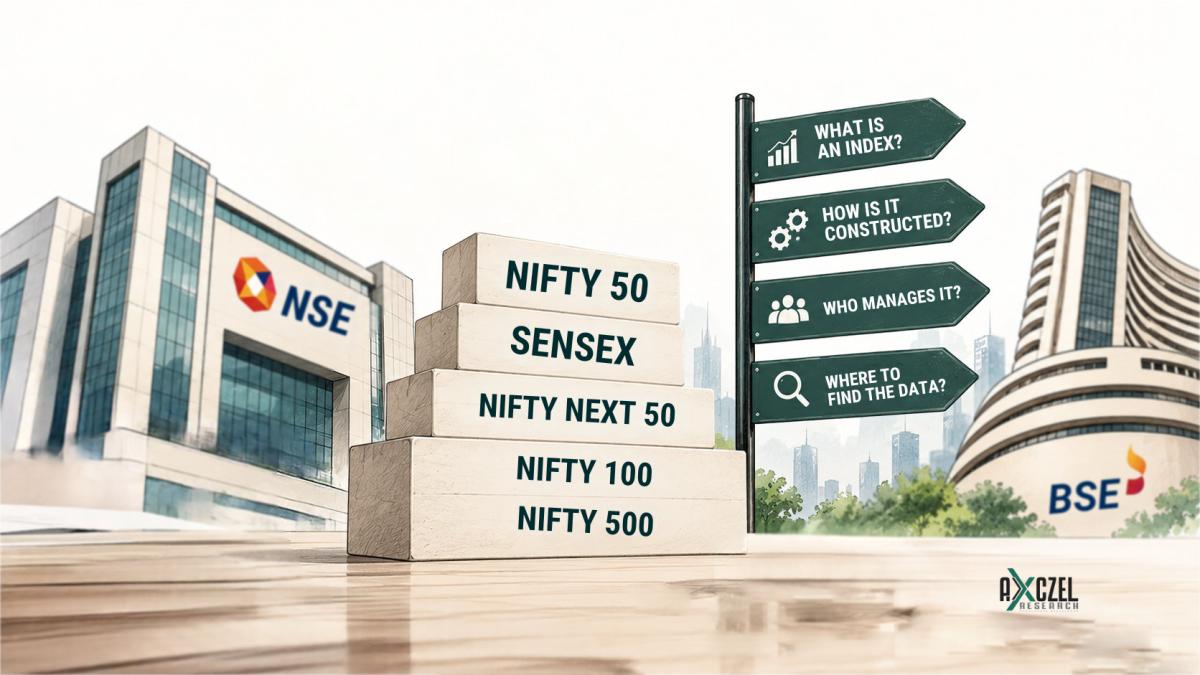
Where this post comes from: This piece was prompted by the September 2026 Nifty reshuffle — BSE Ltd entering the Nifty 50 in place of Wipro. We used that as a jumping-off point to explain, in plain English, what a stock market index actually is, who owns and runs India’s big indices, and how a company gets added or dropped.
On September 30, 2026, something is set to change quietly in millions of Indian investors’ portfolios — even though most of them won’t do anything. The rules behind that change, the Nifty 50 selection criteria, are public, and this guide walks through them.
BSE Ltd, the company that runs the Bombay Stock Exchange, is set to join the Nifty 50 — the 50-stock index that most Indian mutual funds and index funds use as their benchmark. It will take the place of Wipro, the IT services giant, which has been a Nifty 50 member for over a decade.
This isn’t a one-off. It’s part of a routine, twice-a-year housekeeping exercise that NSE Indices Limited — the company that owns and manages the Nifty family of indices — carries out every March and September. This time around, the Nifty Next 50 is set to see five changes too: Indian Hotels, Lodha Developers, REC, Shree Cement and United Spirits are making way for Hitachi Energy India, Polycab India, Vedanta Aluminium Metal, Vodafone Idea, and — moving down from the Nifty 50 — Wipro itself. The ripple effects will be felt in the Nifty 100 as well, since it’s simply the Nifty 50 and Nifty Next 50 put together.
If you’ve ever wondered why an index changes its members, who gets to decide, and where you can check this yourself instead of waiting for a headline to tell you — this explainer on Nifty 50 selection criteria is for you.
First, what exactly is an “index”?
A stock market index is simply a basket of stocks (or bonds, or other securities) grouped together to represent the performance of a market or a segment of it. Instead of tracking thousands of individual companies to know “how is the market doing today,” you can just look at one number — the index.
India has indices for almost every slice of the market you can think of: the Nifty 50 for large, liquid companies; the Nifty Bank for banking stocks; the Nifty 500 for a much broader slice of listed companies; even thematic ones like Nifty Commodities or company-specific ones like the Nifty Tata Group index.
Who actually owns Nifty? And who owns Sensex?
This is a question a lot of people get wrong, because “NSE” and “Nifty” get used almost interchangeably in conversation, and the same happens with “BSE” and “Sensex.” But the indices themselves are run by separate, dedicated companies:
| Index | Who manages it | Ultimate parent |
|---|---|---|
| Nifty 50 and the rest of the Nifty family | NSE Indices Limited | National Stock Exchange of India (NSE) |
| BSE Sensex | BSE Index Services Private Limited | BSE Limited |
NSE Indices Limited was set up in May 1998 under the name India Index Services & Products Limited (IISL). It sits within the NSE group — held through NSE’s own investment holding company — and its whole job is to own, build and license Nifty indices. If a mutual fund wants to launch a “Nifty 50 Index Fund” or an exchange wants to list “Nifty 50 futures,” they need a licence from NSE Indices Limited to use the Nifty brand and methodology.
BSE Index Services Private Limited manages the Sensex. This company has changed its name more than once: it started out managing Sensex directly under BSE, was later spun out and known as Asia Index Private Limited, and on August 1, 2025, officially changed its name to BSE Index Services Private Limited — a rebrand the company itself described as reflecting “a closer alignment with its parent company, BSE Ltd.” It is a wholly owned subsidiary of BSE Limited.
Both companies publish detailed rulebooks (called “methodology documents”) that spell out, stock by stock and rule by rule, exactly how each index is built. If you want to see the source documents for yourself:
Nifty 50 selection criteria, in the Nifty equity indices methodology: niftyindices.com/Methodology/Method_NIFTY_Equity_Indices.pdf
BSE indices methodology (covers Sensex and other BSE indices): bseindices.com/Downloads/BSE_Indices_Methodology.pdf
Not all indices are built the same way
Once you’ve picked which companies go into a basket, you still have to decide how much weight each one gets — because a 1% move in a giant company shouldn’t necessarily move the index by the same amount as a 1% move in a small one (or maybe it should, depending on what you’re trying to measure). There are a few standard approaches used around the world, and India uses several of them side by side:
1. Free-float market capitalisation weighting. This is the method behind the Nifty 50 and Nifty 100. A company’s weight in the index is based on its “free-float market cap” — the value of only the shares that are actually available for the public to trade, excluding shares locked in with promoters, the government, or other strategic holders. So a company where promoters hold 70% of shares contributes far less to the index than its total size might suggest, because only the remaining 30% is counted.
2. Equal weighting. Here, every company in the basket gets the same weight, regardless of its size. The Nifty 50 Equal Weight index and Nifty100 Equal Weight index take the familiar Nifty 50 and Nifty 100 baskets and simply give every stock an identical slice, rebalanced periodically. This stops the index from being dominated by its two or three biggest names.
3. Full market capitalisation weighting. This uses a company’s entire market value — promoter holdings included — rather than just the free-float portion. NSE Indices uses this method for some of its corporate-group indices, such as the Nifty Tata Group index, where the point is to measure the combined equity value of every listed Tata company, not just the freely traded part of it.
4. Price weighting. This method weights companies purely by their share price — a stock trading at ₹5,000 pulls the index harder than one trading at ₹500, irrespective of the size of either company. It sounds a little old-fashioned today, and that’s because it is: it dates back to when calculating market capitalisation for hundreds of stocks by hand wasn’t practical. India’s major indices don’t use it, but two of the world’s best-known indices still do: the Dow Jones Industrial Average in the US and the Nikkei 225 in Japan.
There’s also factor weighting, used in some newer “smart beta” strategy indices, where weights are tilted toward a specific factor such as low volatility or momentum rather than size or price alone.
Nifty 50 selection criteria: who decides a company gets added or dropped?
For the Nifty indices, that job belongs to the Index Maintenance Sub-Committee (IMSC) — a committee that includes representatives from NSE Indices Limited alongside independent members from credit rating agencies and capital markets. The IMSC is the body that formally approves every addition and deletion across NSE Indices’ index universe.
But the committee isn’t picking favourites — it’s applying published Nifty 50 selection criteria, an objective rulebook. NSE Indices’ own methodology document puts the core definition plainly: the Nifty 50 represents 50 companies selected from the Nifty 100 universe, based on free-float market capitalisation, and the companies must be liquid enough to have an average impact cost of 0.50% or less for 90% of the observations, for a basket size of ₹10 crore. The constituents must also have derivative (futures & options) contracts available on the NSE. (“Impact cost” here is basically a measure of how much a stock’s price moves just from placing a large order — a proxy for how liquid it is.)
On top of that base definition, the Nifty 50 selection criteria add a couple more conditions, or index constituent rules, that a stock needs to clear to be eligible at the next review:
Trading frequency of 100% of trading days over the review period
An average free-float market cap of at least 1.5 times that of the smallest existing constituent, if it’s meant to replace another stock
There are also guardrails on how much churn is allowed: a maximum of five companies (10% of the fifty) can be added to the Nifty 50 in a calendar year through the regular process, and the market gets at least four weeks’ notice before any change actually takes effect.
The review itself runs on a fixed clock: NSE Indices assesses the Nifty 50 semi-annually, using six months of trading data ending in January and July. Whatever changes are decided are then implemented after the close of trading on the last working day of March and September — which is exactly why September 30, 2026 is reshuffle day this time around.
It’s not just the Nifty 50 — different indices move on different schedules
The Nifty 50 and Nifty Next 50 share the same semi-annual, March/September clock. But that’s not universal across the whole Nifty universe. Based on NSE Indices’ published rebalancing schedule, here’s how the cadence varies by category:
| Category | Typical periodicity | Examples |
|---|---|---|
| Nifty broad market | Semi-annual (March, September) | Nifty 50, Nifty Next 50, Nifty 100, Nifty 500, Nifty Midcap 100 |
| Nifty sectoral | Semi-annual (March, September) | Nifty Bank, Nifty IT, Nifty Auto |
| Nifty thematic | Semi-annual (March, September) | Nifty Infrastructure, Nifty MNC |
| Nifty strategy | Quarterly, semi-annual or annual, depending on the index | Nifty Alpha 50 and Nifty Low Volatility 50 (quarterly); Nifty50 Equal Weight (semi-annual) |
| Nifty fixed income | Varies widely — some move fortnightly or even weekly | G-Sec and T-Bill indices track newly issued securities almost as soon as they’re auctioned |
| BSE Sensex | Semi-annual — effective the Monday after the third Friday of June and December | Sensex |
You can check the exact schedule for any specific index at niftyindices.com/resources/index-rebalancing-schedule.
And how does Sensex decide the same questions?
Since we’ve been talking mostly about Nifty, it’s worth pausing on Sensex — because it runs its own parallel process, with its own committee and its own calendar.
The Sensex is the oldest index in the country and works as both a benchmark and an investable index, comprising 30 large, well-established, financially sound companies across key sectors. Like the Nifty 50, it’s weighted by free-float market capitalisation.
The Sensex is drawn from the BSE 100 universe. Per BSE Index Services’ own methodology document (its Sensex section, pages 12–13), a stock first has to clear a basic eligibility bar: a listing history of at least six months at BSE, having traded on every single trading day at BSE during that six-month window, and a derivative (F&O) contract available on the exchange.
From there, selection is a multi-step ranking exercise, straight from the methodology document: eligible stocks are ranked once by free-float market capitalisation and once by full market capitalisation, and the top 75 from each list are combined. That combined list is then narrowed using liquidity screens — companies making up more than 98% of cumulative traded value are excluded, and so are companies whose weight would be less than 0.5%. A final ranking then decides the 30 seats: the top 21 by rank get in regardless of sector; existing constituents ranked 22–39 fill any remaining seats in order of rank; and if seats are still open after that, new entrants ranked 22–30 are chosen with preference given to sectors currently underrepresented in the index (measured against the broader BSE AllCap).
Instead of the Index Maintenance Sub-Committee (IMSC) that applies the Nifty 50 selection criteria, Sensex additions and deletions are made at the discretion of BSE Index Services’ own index committee — the methodology document states this in a single line, without spelling out the committee’s composition, much as NSE doesn’t publish the IMSC’s exact roster either.
Sensex’s rebalancing calendar, per BSE Index Services’ own methodology document, is semi-annual too, but runs on a more precise clock than Nifty’s: changes take effect on the Monday following the third Friday of June and December, based on data as of the last trading day of the preceding April and October. That’s a genuinely different mechanic from Nifty’s — Nifty implements changes on the last working day of March/September itself, using six months of data ending the preceding January/July, while Sensex works off a fixed “third-Friday-plus-following-Monday” rule with roughly a two-month gap between its reference date and its effective date. (The same June/December schedule also applies to a wider family of BSE’s broad-market indices — BSE 100, BSE 500, BSE SENSEX Next 50 and others — not just Sensex itself.)
For the full methodology, BSE Index Services’ document (linked above) covers Sensex and every other BSE index it manages.
Where to look up the Nifty 50 selection criteria yourself
You don’t need to wait for a news article to tell you what’s changing in an index you’re invested in. A few places worth bookmarking:
niftyindices.com — press releases on every index change, plus the master methodology documents and the rebalancing-schedule page linked above.
bseindices.com — the equivalent home for Sensex and other BSE-managed indices.
NSE’s live market-data pages — for example, nseindia.com’s Nifty 50 page shows the current constituent list and weights for free.
This article is for information and educational purposes only and is not investment advice. Index constituents, weights and rules can and do change — always verify current details on niftyindices.com or bseindices.com before acting on anything here. Any errors in summarising the source material are the author’s own.
Key takeaways
- What is changing: On 30 September 2026, BSE Ltd is set to join the Nifty 50 in place of Wipro. It is part of a routine twice-a-year review that NSE Indices Limited carries out every March and September.
- Who decides, and the Nifty 50 selection criteria: The Nifty indices are run by NSE Indices Limited, whose Index Maintenance Sub-Committee approves additions and deletions by applying a published rulebook. The Sensex is run by BSE Index Services Private Limited, a wholly owned subsidiary of BSE Limited, and its own index committee makes those decisions.
- Where to check: Methodology documents with the full Nifty 50 selection criteria, and press releases, are free on niftyindices.com and bseindices.com, and NSE’s Nifty 50 page shows the current constituent list and weights.
Frequently asked questions
A stock market index is a basket of stocks, bonds or other securities grouped together to represent the performance of a market or a segment of it. Instead of tracking thousands of individual companies, you can follow one number.
The Nifty 50 and the rest of the Nifty family are managed by NSE Indices Limited, which sits within the NSE group. The BSE Sensex is managed by BSE Index Services Private Limited, a wholly owned subsidiary of BSE Limited.
NSE’s Index Maintenance Sub-Committee approves every addition and deletion by applying a published rulebook. A Nifty 50 company is selected from the Nifty 100 universe based on free-float market capitalisation. It must be liquid, with an average impact cost of 0.50% or less for 90% of observations for a basket size of ₹10 crore, and it must have derivatives contracts on the NSE. At most five companies can be added in a calendar year through the regular process, and the market gets at least four weeks’ notice.
NSE Indices reviews the Nifty 50 semi-annually using six months of trading data ending in January and July, and implements changes after the close on the last working day of March and September. The Sensex is also reviewed semi-annually, with changes taking effect on the Monday following the third Friday of June and December.
It is the method behind the Nifty 50 and Nifty 100. A company’s weight is based on the value of only the shares available for the public to trade, excluding shares locked in with promoters, the government or other strategic holders. A company where promoters hold 70% of the shares contributes only the remaining 30% to its weight.
Sources
Main sources
NSE Indices, Press release: Replacements in indices w.e.f. September 30, 2026 (August 10, 2026)
NSE Indices, Methodology Document for NIFTY Equity Indices
BSE Index Services, BSE Indices Methodology
NSE Indices, Index rebalancing schedule
BSE Index Services, Media release: Asia Index Pvt. Ltd. renamed as BSE Index Services Pvt. Ltd. (Mumbai, August 1, 2025)
NSE, NSE Group / NSE Indices company information
NSE, NSE Indices Committees page
Other sources
Angel One, BSE to Enter Nifty 50, Replace Wipro from September 30, 2026
5paisa, BSE to Enter Nifty 50, Replace Wipro in September 2026
NSE Indices, Nifty Tata Group factsheet
Workbook for NISM-Series-VIII: Equity Derivatives Certification Examination (March 2026 edition), Chapter 2: Understanding the Index
I used Claude, an AI assistant, to rephrase my notes to make it reader friendly.