

This post looks at the largest IPO in India: how big each issue was, the issue price, and how much money went to the company versus existing shareholders.
Question: Which is the largest IPO in India, and how much of each big IPO was a fresh issue and how much was sold by existing shareholders?
Short answer
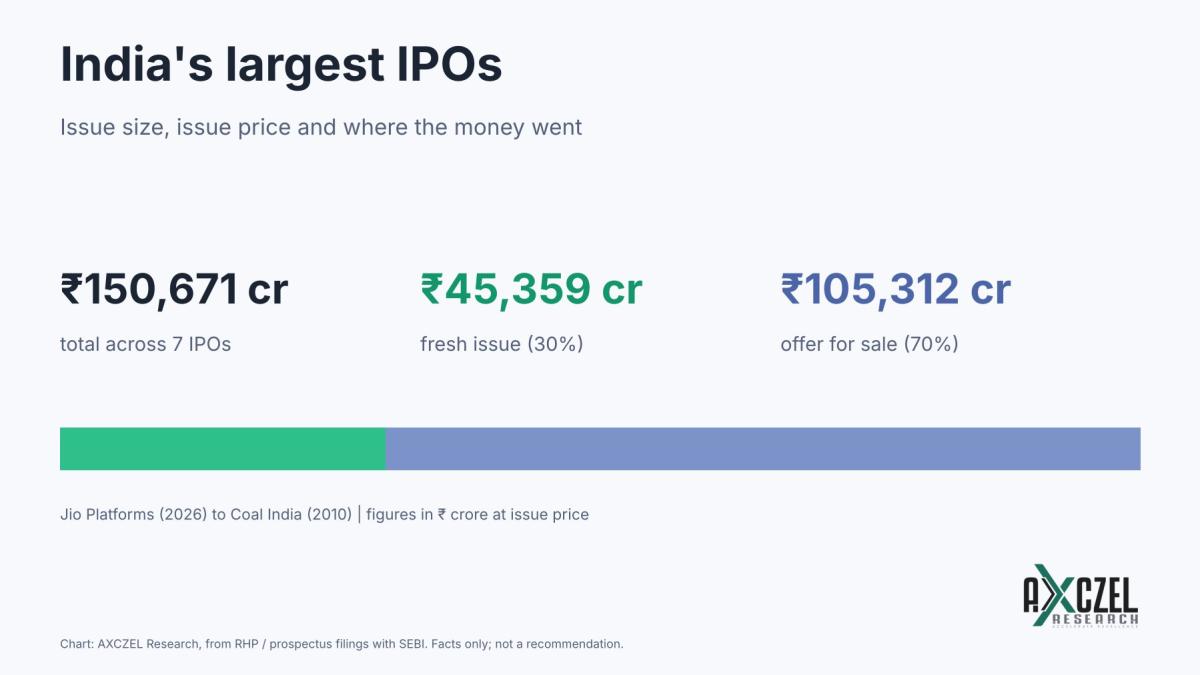
As of 29 October 2026, among the seven biggest IPOs in India, Jio Platforms (2026) is the largest at ₹30,213 crore, and all of it is a fresh issue. Across all seven, about 30% of the total was a fresh issue and about 70% was an offer for sale by existing shareholders. This is a statistical comparison of issue documents, not a view on any company.
Where this post comes from: Jio Platforms’ IPO was listed on 28 October 2026. That made me curious about the biggest IPOs in India, so I dug out the numbers for the seven largest. I took the list from a Google search and checked each IPO against its issue documents. SEBI’s website was my first choice, and I linked it wherever I could open it. Some SEBI documents have blanks for the price or the rupee amounts, and I could not open a few others. For those figures I used news reports, an IPO data site (Chittorgarh), and offer documents hosted by banks. Each source is linked next to the figure and named in the Sources list. This post gives facts only, does not discuss share prices after listing, and is not a recommendation.
Largest IPO in India: the seven biggest at a glance
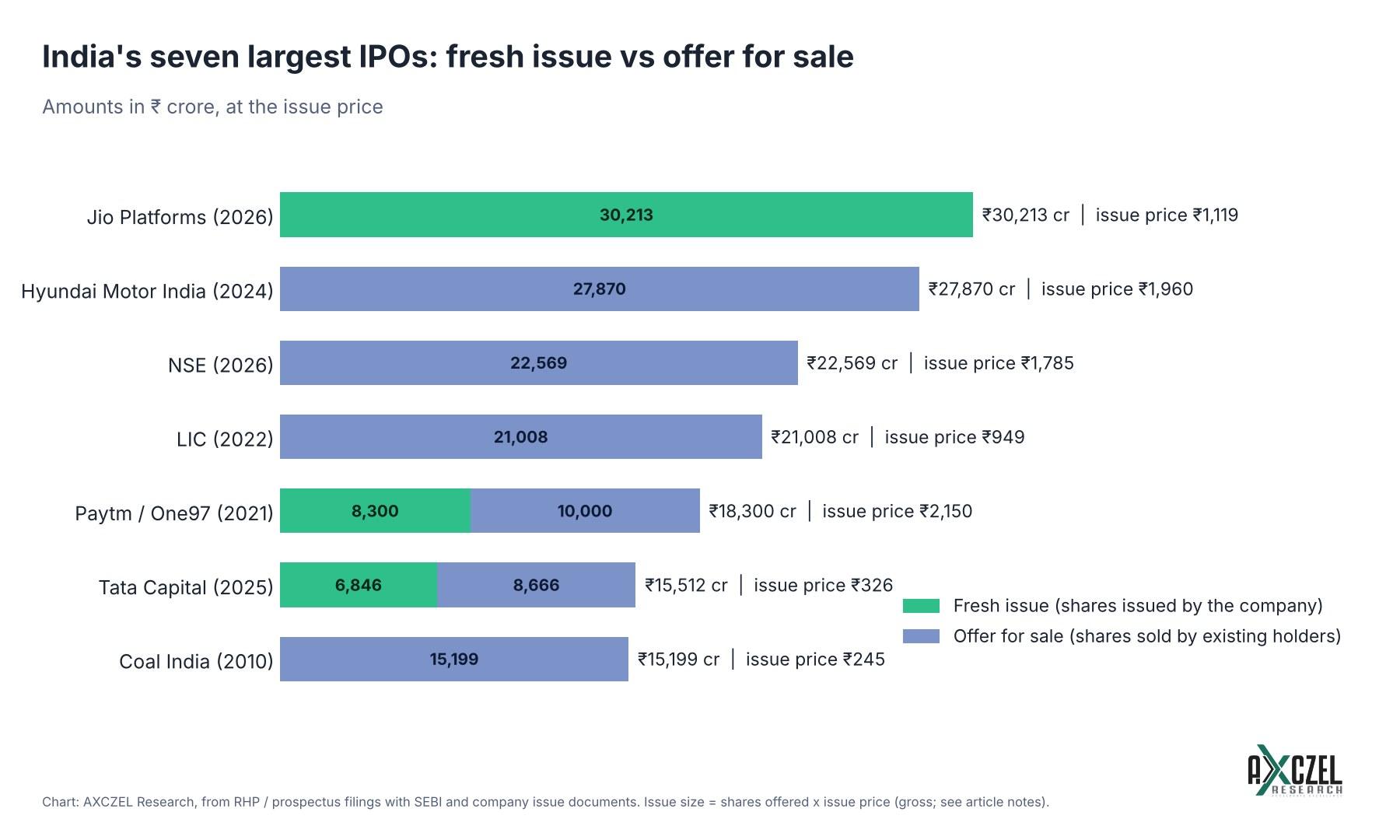
Here are the seven biggest IPOs, ranked by issue size. “Issue size” is the number of shares offered multiplied by the issue price, which is the price at which shares were allotted. All amounts are in ₹ crore. The total issue size is the fresh issue plus the offer for sale.
| IPO (year) | Total issue size (₹ crore) | Issue price (₹ per share) | Fresh issue: money to the company (₹ crore) | Offer for sale: money to the sellers (₹ crore) |
|---|---|---|---|---|
| Jio Platforms (2026) | 30,213 | ₹1,119 | 30,213 | Nil |
| Hyundai Motor India (2024) | 27,870 | ₹1,960 | Nil | 27,870 |
| NSE (2026) | 22,569 | ₹1,785 | Nil | 22,569 |
| LIC (2022) | 21,008 | ₹949 | Nil | 21,008 |
| Paytm / One97 (2021) | 18,300 | ₹2,150 | 8,300 | 10,000 |
| Tata Capital (2025) | 15,512 | ₹326 | 6,846 | 8,666 |
| Coal India (2010) | 15,199 | ₹245 | Nil | 15,199 |
The Jio, NSE, LIC and Coal India numbers are rounded; the notes near the end say how I measured each one.
Fresh issue and offer for sale: what the two terms mean
In a fresh issue, the company creates new shares and sells them to the public. The money goes to the company. In an offer for sale, called OFS, existing shareholders sell shares they already hold. The money goes to those shareholders, and the company gets none of it. An IPO can be fully one, fully the other, or a mix.
A red herring prospectus, or RHP, is the offer document filed before the final price is set. It has the number of shares and the objects of the issue, but the price and the rupee amounts can still be blank. The final prospectus is filed after the price is fixed. An abridged prospectus is a short summary of the RHP with the main details and the bid form. It is based on the RHP, so the offer details are the same.
Largest IPO in India (2026): Jio Platforms, a full fresh issue
The Jio Platforms red herring prospectus is dated October 14, 2026. It offers up to 270,000,000 equity shares as a fresh issue, with no offer for sale. The issue price was ₹1,119 per share (price band ₹1,065 to ₹1,119). At that price, 270,000,000 shares come to ₹30,213 crore.
Eligible employees were given 46,94,835 shares at a discount of ₹54 per share. After that discount, the same data page shows the total as ₹30,187.65 crore.
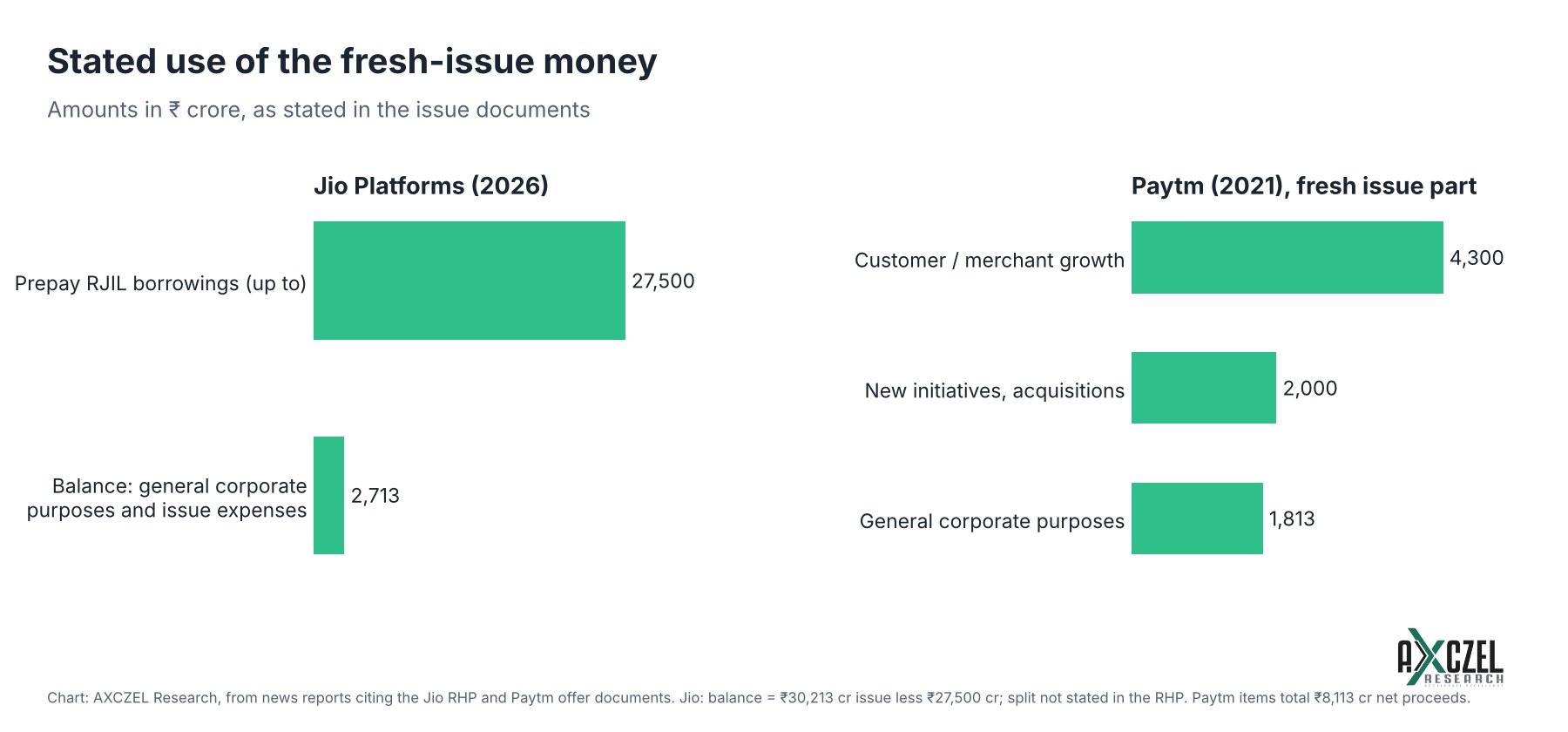
The RHP says the net proceeds will be used to prepay certain borrowings of its material subsidiary, Reliance Jio Infocomm (RJIL), and for general corporate purposes. Outlook Money reports, citing the RHP, that up to ₹27,500 crore of the net proceeds will go to the prepayment, and Multibagg’s RHP summary says the same. The RHP I opened has no rupee amount for general corporate purposes, so I have not shown one.
Largest IPO in India list: Hyundai, NSE, LIC and Coal India were all offer for sale
Hyundai Motor India (2024)
₹27,870 crore at an issue price of ₹1,960. It was a pure offer for sale, and the selling shareholder was the parent, Hyundai Motor Company, so the proceeds went to the seller and not to Hyundai Motor India. Its RHP is on SEBI’s website.
NSE (2026)
The NSE abridged prospectus (a summary of its RHP) shows an offer for sale of up to 126,436,650 shares, and a fresh issue is not applicable. The price band was ₹1,700 to ₹1,785 and the issue price was ₹1,785. At that price, the offer comes to ₹22,569 crore. The largest sellers listed in the abridged prospectus are State Bank of India (up to 1,59,69,410 shares), Canada Pension Plan Investment Board (up to 1,18,74,060) and Aranda Investments (Mauritius) (up to 1,12,46,336). NSE itself gets no proceeds. The sellers cut their offer before the issue opened, which is why some early reports show a bigger number. If you want to see how big investors’ selling is reported, we have an earlier article on tracking bulk and block deals.
LIC (2022)
The LIC abridged prospectus shows an offer for sale of up to 221,374,920 shares by the President of India, acting through the Government of India, and no fresh issue. The issue price was ₹949. At that price, the offer is ₹21,008 crore. Many reports quote ₹21,000 crore. The same report says the government received around ₹20,557 crore, because retail investors and employees got a discount of ₹45 a share and policyholders ₹60.
Coal India (2010)
Coal India’s issue was an offer for sale of 631,636,440 shares by the President of India, through the Ministry of Coal, at ₹245 a share. The offer document gives ₹15,199.44 crore after a 5% discount to retail bidders and eligible employees. Without that discount adjustment, 631,636,440 shares at ₹245 would be about ₹15,474 crore. The filing is on SEBI’s website.
Largest IPO in India list: Paytm and Tata Capital, part fresh and part offer for sale
Paytm (One97 Communications, 2021). The issue price was ₹2,150. Of the ₹18,300 crore, ₹8,300 crore was a fresh issue and ₹10,000 crore was an offer for sale. The biggest sellers were Antfin (Netherlands) Holding at ₹4,704.43 crore, SVF Panther (Cayman) at ₹1,689.03 crore and SAIF III Mauritius at ₹1,327.65 crore. The RHP is on SEBI’s website.
Tata Capital (2025). The issue price was ₹326. The RHP shows a fresh issue of up to 210,000,000 shares and an offer for sale of up to 265,824,280 shares. At ₹326, that is about ₹6,846 crore fresh and ₹8,666 crore offer for sale, for a total of about ₹15,512 crore. The RHP lists the sellers as Tata Sons (up to 230,000,000 shares) and International Finance Corporation (up to 35,824,280 shares), which is about ₹7,498 crore and ₹1,167.87 crore at ₹326. The fresh-issue money is meant to strengthen its Tier-1 capital base, including for onward lending. The RHP is on SEBI’s website.
Largest IPO in India: fresh issue vs offer for sale, together
Taken together, the seven issues on this largest IPO in India list add up to ₹1,50,671 crore. Of that, ₹45,359 crore (about 30%) was a fresh issue and ₹1,05,312 crore (about 70%) was an offer for sale. Jio Platforms was fully fresh. Hyundai, NSE, LIC and Coal India were fully offer for sale. Paytm was about 45% fresh and Tata Capital about 44% fresh. These are my own sums from the figures above.
Largest IPO in India: where the fresh-issue money was meant to go
Only the issues with a fresh part have objects of the issue to report. For Jio, up to ₹27,500 crore is for prepaying RJIL borrowings, which is most of the issue. For Paytm, the listed objects are ₹4,300 crore for growth of its ecosystem, ₹2,000 crore for new initiatives and acquisitions, and ₹1,813.40 crore for general corporate purposes. These three add up to ₹8,113 crore, which the same page gives as the net proceeds of the ₹8,300 crore fresh issue. For the issues that were fully offer for sale, the money went to the selling shareholders.
How I measured the issue size
I used shares offered multiplied by the issue price for every IPO, so the sizes can be compared. Sources do not always agree, so here is where they differ:
NSE: one report shows ₹22,561.57 crore; 12,64,36,650 shares at ₹1,785 give ₹22,568.94 crore, which I rounded to ₹22,569 crore.
LIC: news reports often say ₹21,000 crore; the shares times price is ₹21,008 crore; the government received about ₹20,557 crore after discounts.
Coal India: I used the ₹15,199.44 crore in the offer document, which is after the 5% discount.
Jio Platforms: the RHP I could open has blanks for the price and the rupee amount, so the issue price comes from an IPO data page and the news reports linked above. Some reports say ₹30,213 crore; the same data page shows ₹30,187.65 crore after the employee discount.
Tata Capital: the RHP has blanks for the rupee amounts, so the fresh issue (₹6,846 crore) and the offer for sale (₹8,666 crore) are the share counts in the RHP multiplied by the ₹326 issue price. They match the IPO data page.
This post is for information only. It is not investment advice and it does not recommend any company or IPO. Figures can differ between sources and may change, and any mistakes in summarizing the documents are mine.
Key takeaways
- Largest of the seven: Jio Platforms (2026) at ₹30,213 crore is the largest IPO in India on this list as of 29 October 2026, and all of it is a fresh issue.
- Mostly offer for sale: Hyundai, NSE, LIC and Coal India had no fresh issue, so the company received nothing; the money went to the sellers.
- Mixed issues: Paytm (₹8,300 crore fresh, ₹10,000 crore OFS) and Tata Capital (₹6,846 crore fresh, ₹8,666 crore OFS) had both parts.
- Overall split: across the seven, about 30% was a fresh issue and about 70% was an offer for sale (my own sum).
- What this does not show: this is a comparison of issue documents. It says nothing about how any company or share did after listing.
Frequently asked questions
As of 29 October 2026, among the seven biggest IPOs compared here, Jio Platforms is the largest at ₹30,213 crore, followed by Hyundai Motor India at ₹27,870 crore.
In a fresh issue, the company sells new shares and receives the money. In an offer for sale, existing shareholders sell their shares and receive the money.
Hyundai Motor India, NSE, LIC and Coal India. Each had a fresh issue of nil, so the company did not receive the proceeds.
None. The RHP shows a fresh issue of up to 270,000,000 shares and an offer for sale of “not applicable”.
It is the offer document filed before the final price is set. It gives the number of shares and the objects of the issue, and the price and rupee amounts can still be blank. The final prospectus follows once the price is fixed.
Jio Platforms ₹1,119, Hyundai Motor India ₹1,960, NSE ₹1,785, LIC ₹949, Paytm ₹2,150, Tata Capital ₹326 and Coal India ₹245. The links are in the table above.
Sources
Main sources
Jio Platforms, Red Herring Prospectus and Abridged Prospectus (SEBI)
NSE, Abridged Prospectus (SEBI)
Hyundai Motor India, RHP page (SEBI)
Hyundai Motor India, Prospectus (SEBI)
Jio Platforms IPO size (Free Press Journal)
Jio Platforms IPO debt and use of proceeds (Outlook Money)
Jio Platforms RHP summary (Multibagg)
Hyundai Motor India IPO size (Outlook Business)
NSE IPO issue size (Angel One)
LIC, Abridged Prospectus (BofA)
Paytm (One97), RHP page (SEBI)
Tata Capital, RHP (copy hosted by BNP Paribas)
Paytm (One97), issue summary (Morgan Stanley India offer documents)
Coal India, filing page (SEBI)
Other sources
Jio Platforms IPO details (Chittorgarh)
Paytm IPO details (Chittorgarh)
Tata Capital IPO details (Chittorgarh)
Tata Capital issue price and use of funds (PTI, The Week)
NSE price band (Outlook Business)
NSE offer size reduced (Outlook Business)
LIC issue price and discounts (PTI, Business Standard)
Coal India IPO summary (Business Standard)
Our earlier article on bulk and block deals
Our earlier article on how indices are decided
I used Claude, an AI assistant, to rephrase my notes to make it reader friendly.