

Want to see which stocks are in the MSCI India Index? There is a free and simple way to find the list, and it uses an ETF.
Question: How can I find the list of stocks in the MSCI India Index for free?
Short answer
Open the website page of any MSCI India ETF and look at its basket or portfolio. It lists the stocks the ETF holds, and the ETF follows the MSCI India Index. I compared the portfolios of all four MSCI India ETFs. All had the same 165 securities. You can also track MSCI’s rebalancing by comparing the list from two different dates. This is one day’s list and it changes when MSCI changes the index.
Where this post comes from. The ETF lists come from the fund house websites: DSP, Kotak, Aditya Birla Sun Life and 360 ONE. I opened the page of each of the four ETFs. I compared them, and all four had the same 165 securities. 360 ONE gives a factsheet and a monthly disclosure. The two DSP files from 28 August and 5 October 2026 were downloaded by me from the DSP date picker, so there is no separate public link to those files. The rules part comes from SEBI documents and from notices of fund houses that quote the rules.
Why the MSCI India Index matters
MSCI is a global index provider. Its MSCI India Index covers large and mid-sized Indian companies, about 85% of the Indian equity universe by free float market value (free float means the shares that are available to buy and sell in the market). The latest factsheet I found, for 31 July 2026, shows 165 companies in it.
In our earlier article on Indonesia we saw how much an MSCI decision can matter. MSCI has proposed moving Indonesia from the Emerging Market group to Standalone Market. It is a proposal, and MSCI says the final decision will come by 30 June 2027. This post is not about why. I only want to show how big MSCI’s lists are.
We also wrote about how MSCI rebalancing works and how often it happens. In short, MSCI reviews its indexes every quarter. The dates for the next reviews are published in advance.
This post is about one thing. Say you want to know which stocks are in the MSCI India Index. How do you find the list?
A short word on ETFs
An ETF is a type of mutual fund whose units trade on the stock exchange like a share, as NISM explains. An ETF that follows an index holds the stocks of that index. So if I look at what the ETF holds, I see the index stocks.
How to find the MSCI India Index stocks list using an ETF
Here is what I did.
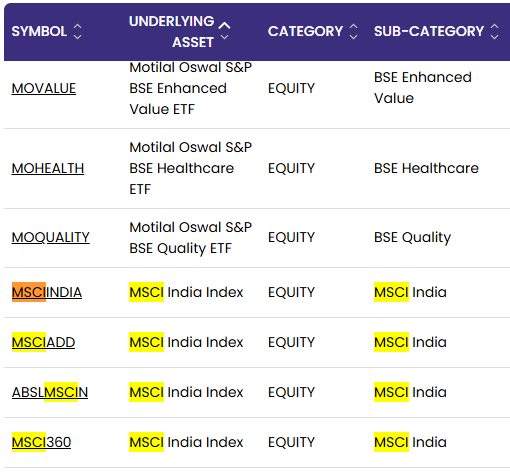
1. I opened the NSE page for exchange traded funds and searched for “MSCI”. Four ETFs show MSCI India Index as the underlying asset: MSCIINDIA, MSCIADD, ABSLMSCIN and MSCI360. The last one is the 360 ONE MSCI India ETF listing. BSE may have such ETFs too. I did not check it, and for this article I used the NSE page only.
2. I picked one. For this example I took MSCIADD, which is the DSP MSCI India ETF. I picked it at random.
3. I opened the DSP ETF basket page. It has a date box and a download button. It shows the security name, ISIN, quantity and more. On 5 November 2026 it showed 165 entries, with the cash component as on 4 November 2026.

I also compared the monthly portfolio that the Aditya Birla Sun Life MSCI India ETF page lets you download. It had 165 securities too. The Kotak MSCI India ETF page also shows a creation unit basket. You can pick a date and download it. I checked it too, and it had 165 securities.
The lists matched. That is what you would expect, because they follow the same index.
Which ETF websites show the MSCI India Index list?
I also wanted to know if the other fund houses show the list. This is what their pages showed on 5 November 2026.
| ETF | What I found |
|---|---|
| DSP MSCI India ETF | Basket page with a date box and download. 165 entries. |
| Kotak MSCI India ETF | Creation unit basket on the scheme page. 165 securities. |
| Aditya Birla Sun Life MSCI India ETF | The scheme page has a monthly portfolio download, which I compared (165 securities). There is also a creation basket page with a date box, but it showed “NA” when tried for 3 and 4 November 2026. So I could not confirm that it gives daily data. |
| 360 ONE MSCI India ETF | The ETF page has a factsheet and a Monthly Disclosure Document. I did not find a daily basket there. |
So not every fund house gives daily data in an easy way. DSP and Kotak let you pick a date. Aditya Birla Sun Life and 360 ONE give monthly files.
Did the MSCI India Index list change after the August 2026 review?
To check this, I compared two DSP snapshots, 28 August 2026 and 5 October 2026, looking only at the Security column. There were 4 securities added and 4 removed. The total stayed at 165.
| Added | Removed |
|---|---|
| Adani Energy Solutions | Astral |
| Billionbrains Garage Ventures | Balkrishna Industries |
| Laurus Labs | SBI Cards and Payment Services |
| Lenskart Solutions | Swiggy |
Three of these changes match MSCI’s August 2026 review. In that review, four stocks were added and three removed, and the changes were done after the market close on 31 August. That moved the count from 165 to 166.
The fourth change, Swiggy, was a separate event. MSCI announced on 2 September that Swiggy will be deleted from 7 September 2026, and said it falls under the foreign ownership limit event category. That took the count back from 166 to 165. So the ETF data showed both the August review and the Swiggy deletion.
The next regular review will be announced on 11 November 2026, with changes taking effect from 1 December 2026. The list I showed above can change after that.
Do ETFs and mutual funds have to publish their portfolio? What do the rules say?
I also checked this. A web search result said that both mutual funds and ETFs must disclose their holdings, but the frequency differs. Here is what I found for India.
Mutual funds, including ETFs. An ETF is a mutual fund scheme, so the same SEBI mutual fund rules apply. The SEBI (Mutual Funds) Regulations, 2026 came into force on 1 April 2026 and replaced the 1996 regulations. SEBI also issued a Master Circular for Mutual Funds on 20 March 2026 with the detailed requirements.
Monthly portfolio. A DSP notice quotes Regulation 70(3) of the SEBI (Mutual Funds) Regulations, 2026 and clauses 6.1.1 and 6.1.3 of the Master Circular for the monthly portfolio. I read the Master Circular itself. Paragraph 6.1.1 says every mutual fund scheme discloses its portfolio, with ISIN, as on the last day of the month, on the fund house website and on the AMFI website, within 10 calendar days from the close of each month, in a downloadable spreadsheet format. SEBI’s own FAQ for mutual fund investors says the same. The 360 ONE MSCI India ETF page also offers a Monthly Disclosure Document.
Passive funds. The same Master Circular has a chapter on passive funds. Paragraph 20.5.4(b) says that equity passive schemes disclose their portfolio within 10 calendar days from the close of each quarter, and paragraph 20.5 says this applies whether or not the fund house is registered under the MF Lite framework. It first came in SEBI’s 31 December 2024 circular. It covers passive funds on domestic equity indices from a list that AMFI sets, where the collective AUM is Rs 5,000 crore or more. I did not check whether the MSCI India Index is on that list. The four ETFs I looked at show their holdings monthly or more often.
Daily list. The daily list you see on DSP and Kotak is the creation basket. In an ETF, large investors exchange a basket of shares with the fund house to create or redeem units. The Master Circular requires the iNAV of an ETF to be shown on the stock exchange during trading hours, and for equity ETFs within 15 seconds (paragraph 4.5.9). I searched the whole Master Circular and found no clause that requires the creation basket to be published every day. A Nippon India ETF product note lists daily disclosure of the portfolio deposit (the basket) as a feature of the ETF structure. So I treat the daily list as how ETFs work in practice. I did not find it as a rule in the regulations.
Exchange rule. For units listed on an exchange, a summary of Regulation 90(1) of the SEBI LODR Regulations on ca2013.com says the listed entity tells the exchange the daily NAV, monthly portfolio and half yearly portfolio of the scheme. I could not check this against SEBI’s own copy.
The US is different. The J.P. Morgan page and the search result I looked at seem to be about the US. There, the SEC’s ETF rule requires an ETF to post its portfolio holdings on its website every business day. Do not assume the same daily rule applies in India.
What to keep in mind about the MSCI India Index list
The list on an ETF page is for one date. After MSCI’s next review it can change.
The ETF holds the index stocks, but it can hold a little cash and its weights can differ slightly from the index.
Being in an index is decided by MSCI’s rules. For example, MSCI classed the Swiggy deletion as a foreign ownership limit event, as reported by Kotak Neo and Outlook Money. So an index list is not a rating of a business.
You can try the same steps with other ETFs on the NSE list.
For education only – not a recommendation. Investment in securities market are subject to market risks. Read all the related documents carefully before investing. AXCZEL Research (Axczel Research Private Limited), SEBI Registered Research Analyst, Reg. No. INH000027681. This article is for information only. It is not investment advice. Figures and rules can change, and any mistakes in summarising are mine.
Key takeaways
- The trick: Open an MSCI India ETF page and read its basket or portfolio. It shows the stocks of the index, as the factsheet lists them.
- What I found: I compared the portfolios of DSP, Kotak, Aditya Birla Sun Life and 360 ONE. All four had the same 165 securities.
- It tracks changes: Between 28 August and 5 October 2026, 4 stocks came in and 4 went out. Three were from MSCI’s August review and one was Swiggy.
- The rules: SEBI’s Master Circular says every mutual fund scheme, ETFs included, publishes its portfolio within 10 days of month end. Covered equity passive schemes can do it quarterly. I did not find a rule for a daily list in India.
- What it cannot show: The list is for one date, and the next MSCI review is announced on 11 November 2026.
Frequently asked questions
Open the page of an ETF that follows the MSCI India Index, such as the DSP MSCI India ETF basket page, and read the security list.
The NSE ETF page shows four with MSCI India Index as the underlying: MSCIINDIA, MSCIADD, ABSLMSCIN and MSCI360, as seen on the NSE page on 5 November 2026.
The 31 July 2026 factsheet shows 165. After the August review the count went to 166, and the DSP basket page showed 165 on 5 November 2026 after the Swiggy deletion.
Yes. SEBI’s Master Circular says every scheme, ETFs included, publishes its portfolio on the fund house website and the AMFI website within 10 days of month end. Some equity passive schemes can do it quarterly. The daily list on ETF pages comes from the creation basket, and I did not find a rule that makes it mandatory.
The next regular review is announced on 11 November 2026, and changes take effect from 1 December 2026.
Sources
Main sources
DSP MSCI India ETF basket page (fund house)
Kotak MSCI India ETF page (fund house)
NSE exchange traded funds page
DSP monthly portfolio notice citing Regulation 70(3)
SEBI FAQ for mutual fund investors
SEBI Master Circular for Mutual Funds, 20 March 2026 (PDF)
Other sources
Index factsheet, April 2025 and 31 July 2026
Aditya Birla Sun Life MSCI India ETF scheme page and creation basket page
360 ONE MSCI India ETF NSE listing circular and 360 ONE MSCI India ETF page
Free Press Journal on the August 2026 review, PL India list of changes, Business Today
Outlook Money on Swiggy deletion and Kotak Neo
Antara on the next MSCI review
Metro TV on MSCI’s Indonesia proposal
iPleaders on the SEBI (Mutual Funds) Regulations, 2026
SEBI circular on passive schemes, 31 December 2024 (extract)
Summary of SEBI LODR Regulation 90 on ca2013.com
Faegre Drinker on the SEC ETF rule
I used Claude, an AI assistant, to rephrase my notes to make it reader friendly.