

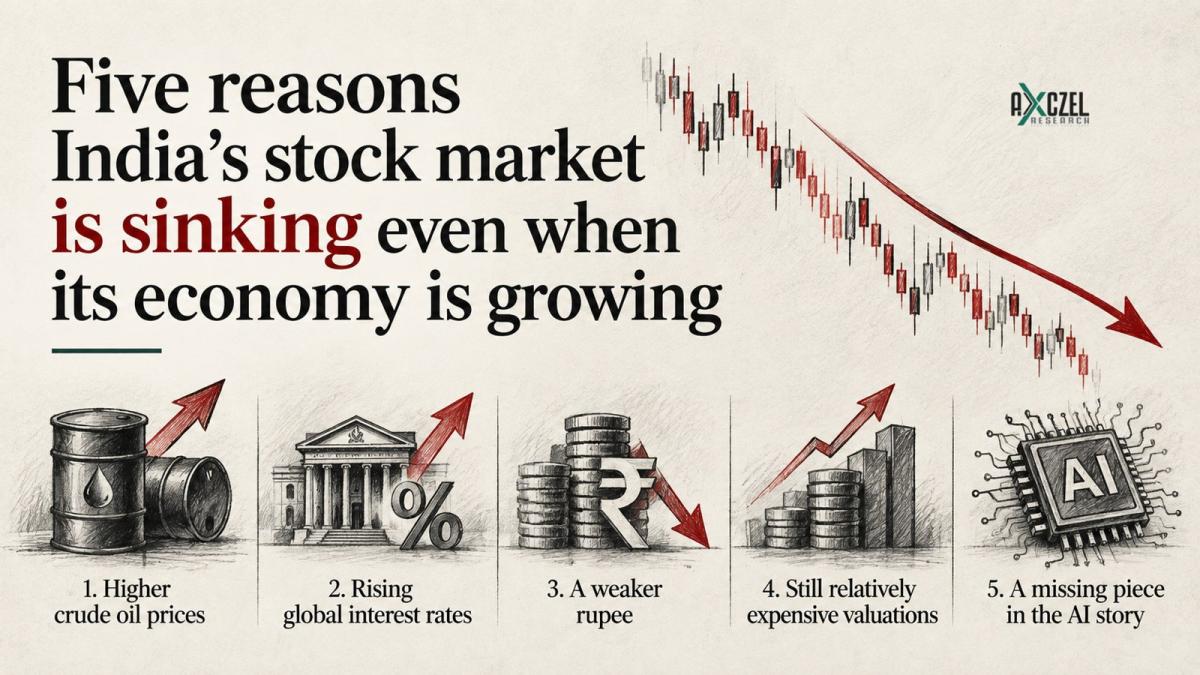
Where this post comes from: This post explains the Indian stock market falling trend, and why it is happening even as the economy grows. The five-reason structure comes from a BBC article titled “Five reasons India’s stock market is sinking even when its economy is growing” (BBC). We have added figures from other reports, each linked where it appears. Market numbers change every day, so the date of each figure is given.
On 31 August 2026, Prime Minister Narendra Modi called India’s 7.8% growth in the first quarter of FY 2026-27 “a herculean feat”. GDP, or gross domestic product, is the total value of goods and services an economy produces in a period. The number also beat the RBI’s own forecast of 7%.
The stock market went the other way. The Nifty 50, the index of India’s 50 large listed companies, fell about 7.7% from its 31 August close to its low in early October, based on NSE data. The index is also about 15% below its January record and has just had its longest run of weekly losses in 25 years.
So why is the Indian stock market falling when the economy is growing so well?
Why is the Indian stock market falling when the economy is growing?
GDP and share prices measure different things. GDP looks back at what the economy has already produced. Share prices look forward. They reflect what investors expect companies to earn, how risky things look, and where money is flowing.
Foreign money matters a lot here. Foreign portfolio investors (FPIs) are overseas funds that buy Indian shares and bonds. When they sell, prices fall, even if the economy is healthy. Foreign selling has been heavy: outflows reached a record $27.8 billion in 2026.
The BBC points to five pressures behind this. Here they are, one by one.
Reason 1: Crude oil prices and the Indian stock market falling
India buys most of its oil from abroad. The BBC puts the share at over 90% of its needs, although other reports say over 80%. Either way, the dependence is very high. The BBC also notes that nearly half of India’s crude imports, plus a large share of its LPG and LNG, travel through the Strait of Hormuz, a narrow sea route between Iran and Oman.
Prices are high. Brent crude, the global benchmark, traded above $106 a barrel on 29 September. The BBC wrote of crude above $101 when it published.
Why does this hurt shares? A higher oil bill raises costs for businesses and pushes up prices. One analyst at SMC Global Securities says higher crude widens the current account deficit and weakens the rupee. The current account deficit is the gap when a country spends more abroad than it earns from the world.
Reason 2: Interest rates are rising around the world
A bond is a loan to a government, and the yield is the return the lender earns. The BBC says US government bond yields are above 5%, near 25-year highs. On 29 September, the US 10-year yield was near 5.23%.
When a safe US bond pays that much, some global investors move money out of riskier markets like India. That selling is visible: on the same day, foreign investors sold more than ₹5,353 crore of Indian shares for a third session in a row.
We have explained the link in an earlier article, why US bond yields are bad news for Indian stocks. Home rates matter too. The RBI held its repo rate at 5.25% in August, and its next decision is due on 7 October 2026. We wrote this before the announcement, so we do not know the outcome. Our earlier piece covers what economists expected from the RBI in October 2026.
Reason 3: A weaker rupee hurts foreign investors
Foreign investors count their returns in dollars. If the rupee falls, their Indian holdings are worth fewer dollars, even when share prices do not move.
The rupee has had a hard year. By mid-May it had lost over 6% in 2026 and was Asia’s worst-performing currency. On 20 May it closed at a record low of 96.83 per dollar. We have not found a reliable current rate, so please check a live source for today’s level.
Here is a simple example, not real data. If Indian shares rise 5% but the rupee falls 6%, a dollar investor ends up slightly behind. That is why a weak rupee adds to the pressure on the Indian stock market.
Reason 4: Indian stocks are cheaper, but still not cheap
A valuation tells you how much investors pay for each rupee of profit. The BBC says Indian shares remain expensive compared with their earnings, especially next to companies in South Korea and Taiwan.
Reports differ, partly because they use different measures. Ambit Capital says India trades at nearly 20 times trailing twelve-month earnings, which looks back at the last year’s profit. Hermes Investment Management puts it at around 24 times forward earnings, which looks ahead. Standard Chartered, on the other hand, wrote on 24 September that India’s valuation is now in line with its long-term average.
One way to see how foreign investors are faring is the Nifty India FPI 150 Index. It tracks 150 stocks from the Nifty 500 chosen to be easy for foreign investors to buy. Going by its chart on the NSE Indices site, the index fell roughly 13% from January 2026 to its low in March, and it has not yet recovered.
An index only shows the average. Under the surface, 252 of the Nifty 500 stocks, or 50.4%, are at least 30% below their own highs. Some individual shares may be reasonably priced, but we have not screened stocks here and this is not a stock recommendation.
Reason 5: The AI gap and the Indian stock market falling
The BBC calls AI, and the new economy more broadly, a major missing piece of India’s growth story. Other analysts agree. Standard Chartered says India is not an AI growth story the way Korea and Taiwan are, and that Taiwan’s earnings could grow well over 40% through 2026-27.
The gap shows in market size. On 25 May, Taiwan’s market value of $4.95 trillion passed India’s $4.92 trillion, and Taiwan’s and Korea’s market values had risen 52% and 69% in 2026 by then.
India is working on this. Our earlier articles look at India’s semiconductor ambitions, the Nifty AI catalysts index and India’s AI enablers. Building a big AI and chip industry takes years, so it is not a quick fix.
Indian stock market falling: what to watch in the share market next
None of the five pressures is permanent. Oil prices, US yields, the rupee and the RBI’s next steps can all change. There is also a brighter point. Standard Chartered says earnings growth expectations for 2026 and 2027 have picked up to about 14-16%, from below 10% in 2025.
The BBC article is a useful checklist. When someone asks why a growing economy has a falling market, these five items are a good place to start. This is a summary of challenges, not a forecast.
This post is for information only and is not investment advice. Figures may change after publication. Any mistakes in summarising the sources are our own.
Key takeaways
- The puzzle: India’s GDP grew 7.8% in Q1 FY 2026-27, yet the Nifty 50 fell about 7.7% from its 31 August close to its low in early October, based on NSE data.
- Five pressures: The BBC lists high crude oil, rising global interest rates, a weak rupee, still-high valuations and the missing AI boom.
- Foreign money is the link: Foreign outflows hit a record $27.8 billion in 2026, which can pull prices down even when the economy is strong.
- Not all one-sided: Standard Chartered expects earnings growth of about 14-16% in 2026 and 2027.
- What it cannot tell you: This is a summary of challenges. It does not predict the market or recommend any share.
Frequently asked questions
GDP looks at past output, while share prices look at future profits and where money is flowing. The BBC points to high oil prices, rising global interest rates, a weak rupee, still-high valuations and a lack of AI-linked companies as the main pressures.
We cannot explain any single day. The pressures described in this article, such as oil, US yields and foreign selling, were the main drivers cited recently. The Nifty 50 fell about 7.7% from its 31 August close to its low in early October, based on NSE data.
India imports most of its oil, so higher prices raise costs, add to inflation and widen the current account deficit. Brent crude traded above $106 a barrel on 29 September.
A US bond paying over 5% tempts foreign investors away from riskier markets, and a falling rupee cuts their returns when counted in dollars. The US 10-year yield was near 5.23% on 29 September.
It depends on the measure. Ambit says nearly 20 times trailing earnings, Hermes says around 24 times forward earnings, and Standard Chartered says valuations are in line with the long-term average.
Taiwan and Korea are home to big chip and memory makers that supply the AI boom, while India’s listed market has little of that exposure yet. Standard Chartered says India is not an AI growth story in the same way.
Sources
Main sources
BBC: Five reasons India’s stock market is sinking even when its economy is growing (the five-reason structure this post follows)
PM India: PM lauds India’s 7.8% GDP growth
Goodreturns: Nifty and Sensex are both down about 15% in 2026
Investing Cube: Nifty 50 ends eighth straight week lower
Ground News: Stock markets tumble in early trade on crude oil and foreign outflows
Standard Chartered: Indian equities: A steady bat in hand
Other sources
Onmanorama: India’s GDP grows 7.8% in Q1
LatestLY: Why stock market is down after 7.8% GDP growth
NewsBytes: Indian stock market slides despite Q1 FY2026-27 GDP growth
News Arena: Rupee new low (tag page)
Adda247: RBI Monetary Policy August 2026
5paisa: India faces high-valuation, low-growth challenge
Hermes Investment Management: Asia equities commentary, 17 June 2026
The Wire: Taiwan overtakes India to become world’s fifth largest stock market
NSE Indices: Nifty India FPI 150 Index and advanced chart; Nifty 50 closing and low levels from NSE data
I used Claude, an AI assistant, to rephrase my notes to make it reader friendly.