

This post lists the five RBI rupee measures announced on 10 October 2026, and checks them against RBI’s weekly forex reserves data and the daily rupee price, so you can see the numbers yourself.
Question: What did RBI announce on 10 October 2026 to support the rupee, and what do forex reserves and the rupee show since then?
Short answer
On 10 October 2026 RBI announced five measures: four new rules on rupee derivatives and one special dollar window for three state-run oil companies. USD/INR fell about 1.9% from 9 October to 16 October, which is a stronger rupee. Forex reserves still fell in every week, but the weekly fall was smaller: US$8.6 billion in the week to 9 October and US$5.0 billion in the week to 16 October. The fall was already slowing before the announcement, and this is only a few weeks of data, so it does not prove that the measures caused either change.
Where this post comes from: This post on RBI rupee measures uses RBI’s own press release 2026-27/1305, press release 2026-27/1306 and the circulars behind them. The reserves numbers are from the weekly Excel files on RBI’s Weekly Statistical Supplement page, which I downloaded. The rupee data is daily closing prices of USD/INR (FX_IDC feed) that I downloaded from TradingView as a CSV file. There is no public link for that file. I show only percentage changes, not the prices. The charts and the percentage changes are our own calculations. The two statements by the RBI Governor in this post are not from RBI’s website. They come from a news report of his interview, and the report is linked right next to them.
What are the RBI rupee measures?
The rupee had been weak for months. In the two weeks before the announcement, USD/INR rose about 1.0% (25 September to 9 October). USD/INR is the number of rupees per dollar, so a higher number means a weaker rupee. RBI had also raised the repo rate by 25 basis points to 5.50% on 7 October. We covered what economists expected in our article on the October RBI rate hike.
Then, on Saturday 10 October, RBI issued two press releases: 2026-27/1305 on regulatory measures for the foreign exchange market, and 2026-27/1306 on a special window for oil marketing companies. Here are the five measures, in the order RBI listed them.
1. No rebooking of cancelled contracts. Banks can no longer let a customer rebook a rupee forex derivative contract that was cancelled. Rollover at maturity is still allowed. A forex derivative is a contract to buy or sell a currency at a fixed rate on a later date.
2. A smaller limit without proof of need. A customer could earlier take positions of up to US$100 million without showing an underlying trade. RBI cut this to US$5 million. This also applies to currency derivatives on the exchanges.
3. More paperwork. Banks must now get a written undertaking that the same exposure is not hedged with any other bank.
4. A 20% cash reserve. For contracts above US$2 million that hedge a dollar purchase for current account needs, the bank must keep 20% of the rupee value as cash with RBI. RBI calls this the Foreign Exchange Risk Reserve (FERR). This makes buying dollars through such contracts more costly.
5. A dollar window for three oil companies. From 12 October, RBI sells dollars, through designated banks, to meet the entire daily need of Indian Oil, HPCL and BPCL. So their dollar buying no longer goes to the open market.
The first four are in press release 1305 and the fifth is in press release 1306. Note that the dollar window for oil companies began on 12 October, so the five were announced on one day, but they did not all start on that day. I have checked the start date only for the fifth one. For the first four, please see the RBI circulars linked above for their effective dates. The counting into five is ours, based on how RBI listed them.
Two related steps came just before and after. On 9 October, RBI raised the minimum daily CRR maintenance from 90% to 99% from 16 October, which is a liquidity step. On 12 October, Circular 27 allowed non-deliverable contracts for non-residents only for hedging, and put the same 20% reserve on banks’ own hedges.
The RBI Governor said, as reported by Deccan Chronicle, that these are not capital control measures and that RBI would consider more steps if needed. I could not find this on RBI’s own site, so please treat it as a news report.
What happened to the rupee after the RBI rupee measures?
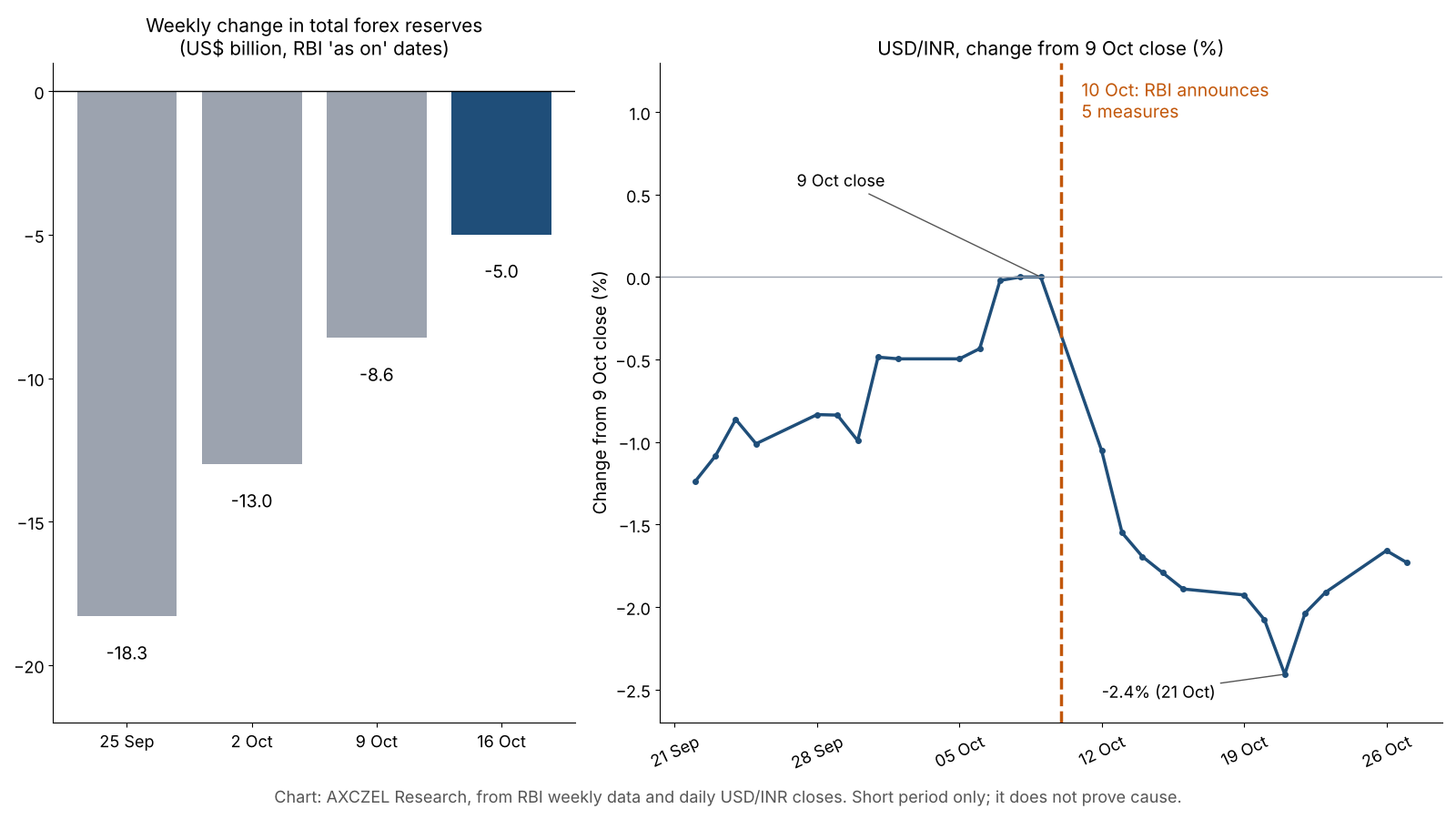
I use the 9 October close as the starting point. On Monday 12 October, the first trading day after the announcement, USD/INR closed about 1.1% lower. By 16 October it was down about 1.9% from 9 October, which means a stronger rupee. The biggest fall was about 2.4% on 21 October, and by 27 October it was down about 1.7%.
If you only look at one price a week, you can miss this move, because it happened over the weekend. That is why I used the daily file.
Before the announcement, the rupee was going the other way. USD/INR rose about 1.0% from 25 September to 9 October.
What happened to forex reserves after the measures?
Total reserves were US$747.6 billion as on 25 September and US$721.0 billion as on 16 October, a fall of about US$26.5 billion. The peak was US$785.7 billion as on 4 September, so from the peak the fall is about US$64.7 billion, or 8.2%.
The weekly falls were US$18.3 billion, US$13.0 billion, US$8.6 billion and US$5.0 billion for the weeks as on 25 September, 2 October, 9 October and 16 October. Reserves fell in every week, but each fall was smaller than the one before. Foreign Currency Assets, the biggest part, fell from US$615.4 billion to US$591.8 billion.
Please note the dates. The RBI table shows the date as on a Friday, and RBI releases it a week later. The figure as on 9 October was set before the dollar window for oil companies started on 12 October. Only the figure as on 16 October covers the first week of the measures. The figure as on 23 October will come out on 30 October, so we will know more soon.
Do the RBI rupee measures explain the numbers?
This is what I can say, and what I cannot.
The fall in reserves was already slowing before the announcement. It went from US$18.3 billion to US$8.6 billion over three weeks, before the dollar window for oil companies started. So I cannot say the measures slowed it.
Reserves can also change when RBI sells dollars, and when the value of the currencies and gold it holds changes. The weekly table does not separate the two. I wrote about this in our article on reading RBI’s weekly forex reserves data.
The Jio Platforms IPO is another thing people mention. It was open from 21 to 23 October. That is after the 16 October reserves date, so it cannot explain the reserve numbers above. It could matter for the rupee after 16 October, but I have no data to say how much.
What I can say is simple. The rupee got stronger right after the announcement, and reserves still fell every week, but the weekly fall got smaller. This is one short period, and it may not always be like this. The point of this post is to show you how to put the RBI table and the daily rupee price side by side, so you can check the next weeks yourself. For another angle on RBI and dollars, see our explainer on FCNR deposits.
How to track RBI rupee measures yourself
1. Open the RBI weekly page and note the “As on” date.
2. Download the daily USD/INR prices from TradingView (the CSV export).
3. Line up each “As on” Friday with that day’s rupee close, and also check the Monday after.
4. Check RBI’s press releases for new measures.
This post is for information only and is not investment advice. Figures may change, and RBI can revise its data. Any mistakes in summarizing the sources are the author’s.
Key takeaways
- What was announced: On 10 October 2026 RBI announced five measures: no rebooking of cancelled contracts, a US$5 million limit without an underlying trade, an undertaking from users, a 20% cash reserve, and a dollar window for three oil companies.
- What the rupee did: USD/INR fell about 1.9% from 9 October to 16 October, and a lower number means a stronger rupee.
- What reserves did: Total reserves fell every week, from US$747.6 billion to US$721.0 billion, but the weekly fall got smaller.
- What it cannot show: The fall was already slowing before the dollar window for oil companies started, so this short period does not prove the measures caused it.
- How to check: Put the RBI weekly table and the daily rupee close side by side, and watch the 23 October figure due on 30 October.
Frequently asked questions
On 10 October 2026 RBI announced five measures: no rebooking of cancelled forex derivative contracts, a lower limit of US$5 million without an underlying trade, an undertaking from users, a 20% cash reserve on certain contracts, and a dollar window for three oil companies.
Under the oil window, RBI says it will sell dollars through designated banks to Indian Oil, HPCL and BPCL. The weekly reserves table does not show how much RBI sold in the market.
It is a cash reserve a bank must keep with RBI, equal to 20% of the rupee value of a qualifying contract above US$2 million that hedges a dollar purchase.
USD/INR fell about 1.9% from 9 October to 16 October, which is a stronger rupee. It is a short period and does not prove the measures caused it.
Yes. Total reserves went from US$726.0 billion as on 9 October to US$721.0 billion as on 16 October. The fall was smaller than in the weeks before.
The Governor said they are not, as reported by Deccan Chronicle. This comes from a news report, not an RBI document.
Sources
Main sources
RBI, Press release 2026-27/1305, Regulatory Measures for the Foreign Exchange Market, 10 October 2026
RBI, Weekly Statistical Supplement, Foreign Exchange Reserves. Weekly Excel files, as on 25 September to 16 October 2026. Changes and percentages are our own arithmetic.
TradingView, USD/INR daily prices (FX_IDC), downloaded as a CSV file. There is no public link for the file. Only percentage changes are shown.
Other sources
RBI, Circular 25, 10 October 2026
RBI, Circular 26 (FERR), 10 October 2026
RBI, Circular 27, 12 October 2026
RBI, CRR daily maintenance circular, 9 October 2026
RBI, Press release on the 7 October 2026 policy
Deccan Chronicle, Open to more steps to curb undue speculation in forex market, says RBI Governor
Reuters via NST, Ambani’s Jio seeks US$3.2b in record India IPO
I used Claude, an AI assistant, to rephrase my notes to make it reader friendly.