
How the world outside India moves Indian markets: US bond yields, oil and OPEC, foreign money flows and the economic data behind the headlines.
Topic
Macro & Global Markets
Start here
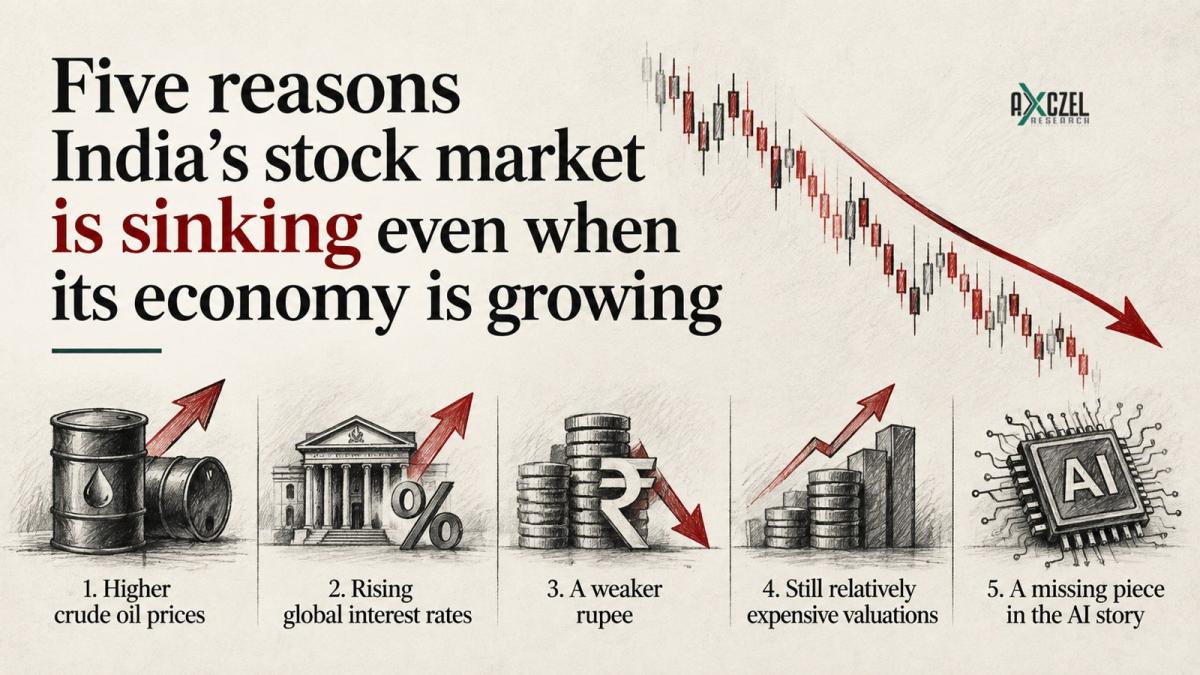
Indian Stock Market Falling Despite 7.8% GDP Growth: 5 Reasons Why
India's GDP grew 7.8% in Q1 FY 2026-27, yet the Nifty 50 fell about 7.7% from its 31 August close to its early-October low. The BBC points to five pressures, high crude oil, rising global interest rates, a weak rupee, still-high valuations and India's missing AI boom, with record foreign outflows of $27.8 billion in 2026 linking them.
October 7, 2026
Is There an AI Bubble? IMF Warns, Then AI Stocks Slide
The IMF did not call AI a bubble: its October 2026 blog flagged three growing risks, a correction in AI-linked prices, a sharp rise in government bond yields and cyberattacks, and warned about the debt building up behind AI spending. A risk warning is not a crash prediction; the open question is valuation, not whether the technology is real.
Oct 16, 2026
OPEC Meeting Update: OPEC+ Keeps November Oil Output Steady
OPEC+ kept its November 2026 production targets at September levels. Because actual output is still about 5 million barrels a day below pre-war levels, the targets are not the real limit, and Brent above $100 a barrel keeps the pressure on oil importers like India.
Oct 5, 2026
Why US Bond Yields Are Bad News for Indian Stocks
With the 10-year US Treasury yield around 5.1% to 5.2%, a near risk-free US return raises the bar Indian stocks must clear, so foreign investors pull money out. That is what happened in September 2026, when FPIs withdrew about ₹20,974 crore by the 18th; it is a story about global capital flows, not a verdict on India's economy.
Sep 29, 2026
Cement Is Booming, Coal Isn’t: What India’s Core Industries Data Just Revealed
India's Index of Core Industries grew 4.8% year-on-year in August 2026 (provisional), down from 5.0% in July and about 6.0% in June. Construction-linked sectors such as cement (+12.5%) and electricity (+11.6%) carried the index, while fertilizers, natural gas, coal and crude oil shrank.
Sep 22, 2026