This update reports news and filings from public sources: NSE, BSE, RBI, PIB, Business Standard, BusinessLine, CNBC-TV18, NDTV Profit, Firstpost, Bloomberg, SEBI, Zerodha, US Federal Reserve, News On AIR, Moneylife, Outlook Business and Angel One. These are not our opinions, and nothing here is a recommendation to buy, sell or hold. We are only passing on what was published. Please check the linked source for each item.
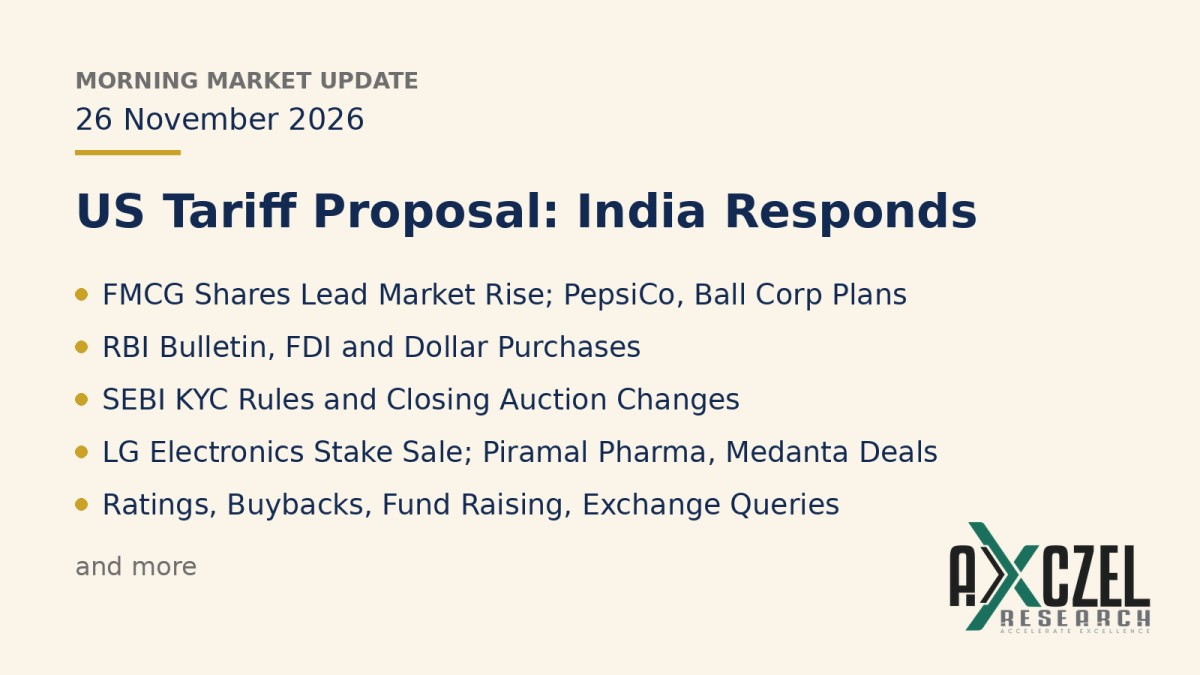
Key points, 26 Nov 2026
- US tariffs: the US proposed tariffs of up to 25% on Indian goods, or 17% if a trade deal is concluded, under a Section 301 investigation of 14 economies; India said it does not have structural excess capacity in any sector.
- RBI data, 25 Nov: net foreign direct investment turned to an outflow of $4.9 billion in September, while RBI was a net buyer of $6.94 billion in the same month.
- SEBI KYC: from 24 Dec 2026, validated KYC records at KYC Registration Agencies can be reused across brokers and other intermediaries.
- BSE: new closing-session rules in equity derivatives from 7 Dec 2026; continuous trading runs to 3:45 pm.
- LG Electronics India: promoter LG Electronics Inc plans to sell up to 2% to meet minimum public shareholding rules.
- FMCG: FMCG companies led Wednesday’s market rise; PepsiCo India announced a ₹868 crore plant in Tamil Nadu and Ball Corporation a ₹2,900 crore can unit in Meerut.
- Cabinet: approved a ₹11,000 crore scheme for construction and infrastructure equipment manufacturing, a second container terminal at Kamarajar Port and a greenfield airport at Silchar.
1. Economy and trade
US tariff proposal: On 25 Nov, the Office of the US Trade Representative (USTR) issued a Notice of Determination and Request for Comments in its Section 301 investigation of 14 economies, including India, on “structural excess capacity” in manufacturing. India’s Department of Commerce said the notice is under examination, that India does not have structural excess capacity in any sector, and that trade concerns should be handled in the India–US Bilateral Trade Agreement talks, which it wants to conclude early. Business Standard reports that the US proposed tariffs of up to 25% on Indian goods, or 17% if a trade deal is concluded, calculated net of existing Section 301 duties. It names other proposed rates, including 20% for China and 18% for Indonesia, Malaysia, Cambodia and Thailand. (also: NDTV Profit, Bloomberg)
Note: Section 301 of the US Trade Act of 1974 lets the USTR investigate trade practices of other countries that it considers unfair to US commerce and propose action such as tariffs. A “Request for Comments” means the proposal is open for public comment before a final decision.
“Structural excess capacity” means a country can produce far more of certain manufactured goods than its own market and normal export demand can take, over a long period rather than for a short spell. It is usually linked to government support such as subsidies or cheap credit, and the surplus may be exported at low prices that hurt producers in other countries. For India, Business Standard reports that the US cited industrial plans, inadequate labour protections, financial repression and market-access barriers; India says it has no such capacity in any sector.
RBI Bulletin, November 2026: The Reserve Bank of India released its monthly Bulletin on 25 Nov. Its press release says domestic activity indicators were resilient in October with strong credit demand, headline consumer price inflation rose slightly on higher food inflation, and the trade deficit narrowed year-on-year. One article finds that imported items make up 8.5% of the new consumer price index basket but contributed about 18% of headline inflation in October 2026. Other articles review non-banking financial companies in 2025-26 and the effect of US monetary policy on Indian markets. The press release and the full Bulletin (PDF) are on the RBI website. The RBI says views in the Bulletin articles are those of the authors.
Foreign direct investment: Business Standard reports, from RBI data, that net foreign direct investment was an outflow of $4.9 billion in September, against an inflow of $3.3 billion in August. Gross inflows were $5.9 billion, repatriation and disinvestment $6.5 billion, and outward investment by Indian companies $4.4 billion. For April–September, net foreign direct investment was $8.8 billion, against $7.4 billion a year earlier.
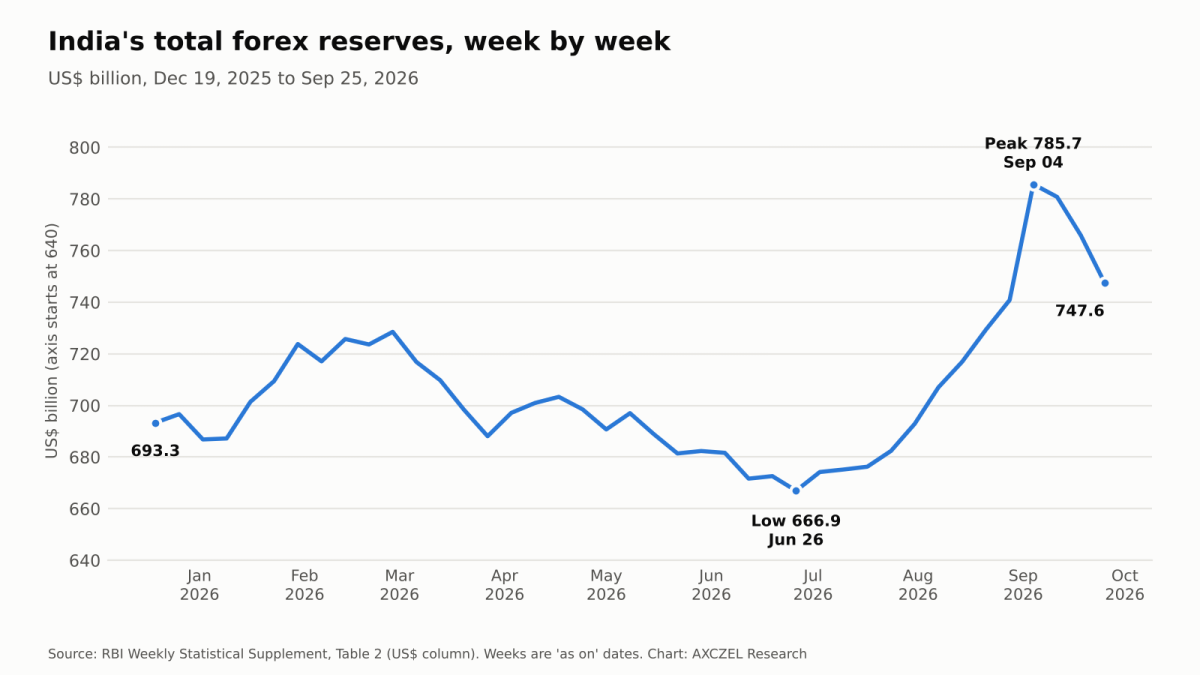
RBI dollar operations: Reuters, carried by BusinessLine, reports that the RBI was a net buyer of dollars for the fourth straight month, buying a net $6.94 billion in September (gross purchases $82.18 billion, sales $75.25 billion), after a net $43.26 billion in August.
NRI deposits and LRS: Business Standard reports, from RBI data, that net deposits by non-resident Indians were $125.59 billion in April–September, against $6.01 billion a year earlier; most came into Foreign Currency Non-Resident (Bank) deposits during the RBI’s swap window for these deposits in June–August. Remittances abroad by resident individuals under the Liberalised Remittance Scheme rose 6.1% to $15.7 billion in the same period; travel was the largest part at $8.88 billion, and remittances for studies abroad fell 36.7% to $801 million.
Note: The Liberalised Remittance Scheme (LRS) of the RBI allows a resident individual to send up to USD 2,50,000 abroad in a financial year for permitted purposes such as travel, education, medical treatment, gifts, maintenance of relatives and overseas investment.
Cabinet: construction equipment scheme: The Union Cabinet approved a ₹11,000 crore scheme to build the domestic manufacturing ecosystem for construction and infrastructure equipment, run by the Ministry of Heavy Industries over eight years from FY2026-27. It has two parts: a sales-linked incentive of 13% to 8% on incremental sales of eligible equipment and components over five years (FY2028-29 to FY2032-33), and up to ₹375 crore as viability gap funding for a dedicated testing facility. The release says India’s construction equipment industry is the world’s third largest, at about ₹97,500 crore in FY2024-25.
Cabinet: Kamarajar Port: The Cabinet Committee on Economic Affairs approved a second container terminal at Kamarajar Port (formerly Ennore Port), costing about ₹4,288.26 crore in a public-private partnership on a design, build, finance, operate and transfer basis with a 40-year concession. Capacity is 2.0 million twenty-foot equivalent units (TEUs) a year in two phases. The release says there is no financial implication for the government.
Cabinet: Silchar airport: The Cabinet Committee on Economic Affairs approved a greenfield airport at Doloo, Silchar, Assam, to be built by the Airports Authority of India at an estimated ₹2,014 crore, with a runway suitable for A-320 aircraft. Two India Post schemes were also approved (PIB, PIB).
PLI for auto: Under the production linked incentive (PLI) scheme for automobiles and auto components, ₹4,385.28 crore has been disbursed in FY2026-27 as of 25 Nov, and ₹6,771.64 crore since the scheme began. Approved applicants report investment of ₹52,806 crore as of 30 Sep 2026 and 77,755 jobs.
Duty-free raw sugar: The Directorate General of Foreign Trade (DGFT) extended the deadline for duty-free import of 10 lakh tonnes of raw sugar under a tariff rate quota from 31 Dec 2026 to 31 Mar 2027, reports BusinessLine, which says the move aims to improve domestic availability and limit price rises. (also: CNBC-TV18)
Note: A tariff rate quota (TRQ) allows a fixed quantity to be imported at nil or low duty, while imports above it pay the normal duty. The government first allowed this 10 lakh tonne quota on 20 Aug 2026, after a sharp rise in domestic sugar prices. The government said current-season production was expected at about 306 lakh tonnes, against an initial estimate of about 343 lakh tonnes by sugarcane-growing states, citing crop disease and waterlogging (PIB). Only mills and refiners able to refine raw sugar could apply, and the refined sugar must be sold in India.
Rooftop solar batteries: BusinessLine reports that the Power Ministry has proposed mandatory battery storage for residential rooftop solar systems above 10 kilowatts, through amendments to the Electricity (Rights of Consumers) Rules proposed to apply from 1 Apr 2027. Comments are invited until 23 Dec 2026.
India–UK investment treaty: Reuters, carried by Business Standard, reports, citing two senior officials, that India does not plan to aggressively pursue a bilateral investment treaty with the UK in the near term, because of differences over tax policy and access to international arbitration. The India–UK trade agreement took effect on 15 July.
2. US data
GDP: Firstpost reports that the US Bureau of Economic Analysis’s second estimate puts third-quarter growth at an annualised 4.3%, up from the advance estimate of 3.4% and from 2.2% in the second quarter.
Inflation and spending: A Bloomberg headline says the core personal consumption expenditures (PCE) price index, the US Federal Reserve’s preferred inflation gauge, rose 0.3% in October for a third month, while consumer spending stalled.
Jobless claims: Initial jobless claims fell by 13,000 to 189,000 in the week ended 21 Nov, according to US Department of Labor data reported by Firstpost.
Beige Book: A Bloomberg headline says the Federal Reserve’s Beige Book survey showed moderate growth and an uptick in wage pressures.
Note: The Beige Book is a report on current US economic conditions that the Federal Reserve publishes eight times a year. Each of the 12 regional Federal Reserve Banks gathers information for its district from business contacts, economists, market experts and other sources, and the report summarises it by district and by sector. It is descriptive rather than statistical, but it gives an early, on-the-ground view of activity, jobs, wages and prices before official data are released, and it comes out about two weeks before each meeting of the Federal Open Market Committee, which sets US interest rates. Signs of rising wage pressure are watched because higher wages can add to inflation.
3. FMCG
Bikaji Foods: The company has entered the premium bakery segment with the Mahè brand under its subsidiary Bikaji Bakes Private Limited, in partnership with master baker T K Khaleel. (also: BSE)
Shreeji Global FMCG: NSE gave in-principle approval for 22,02,280 convertible warrants to be issued on a preferential basis.
PepsiCo India: Business Standard reports that PepsiCo India will invest ₹868 crore in a new foods plant at the SIPCOT Industrial Park near Manapparai, Tamil Nadu, for Lay’s and Kurkure, with about 650 direct and indirect jobs. It is part of a ₹5,700 crore plan to 2030. (also: BusinessLine)
Ball Corporation: Business Standard reports that the global packaging company is setting up an aluminium beverage can plant in Meerut, Uttar Pradesh, with investment of more than ₹2,900 crore; Chief Minister Yogi Adityanath laid the foundation stone.
Packaged drinking water: BusinessLine reports that the Food Safety and Standards Authority of India (FSSAI) widened its checks after a sample of Bisleri packaged drinking water failed a laboratory test; its CEO said samples are being collected across the country and testing will take about two months. CNBC-TV18 reports, citing sources, that the FSSAI has asked states to step up surveillance of packaged water makers, days after it sanctioned prosecution against Bisleri International.
Note: Packaged drinking water is regulated by the FSSAI. In late 2024 the separate mandatory certification by the Bureau of Indian Standards was removed and packaged water was placed in the FSSAI’s high-risk food category, which carries risk-based inspections of manufacturers.
FMCG shares: Business Standard reports that FMCG companies led Wednesday’s market rise, naming Dabur India, Hindustan Unilever, Godrej Consumer Products and Tata Consumer Products, and links it to steady July–September demand, with rural demand supporting consumption and urban demand improving gradually. CNBC-TV18 reports that the Nifty FMCG index is on course for its best month in 17 years.
4. RBI and banking
Bank of India: The All India Bank Employees’ Association, the All India Bank Officers’ Association and the Bank Employees Federation of India have served notice of a strike on 3 Dec 2026. The bank says it is taking steps to keep branches working, but work may be affected. (also: BSE)
IRDAI expert committee: BusinessLine reports that the Insurance Regulatory and Development Authority of India (IRDAI) has formed a six-member expert committee to examine about 2.18 lakh responses to its consultation paper on insurance distribution and to assess the effect of the proposals on policyholders, insurers and distribution channels.
Note: On 23 Sep 2026, IRDAI released a consultation paper, “Recalibrating Economics of Insurance Distribution”, proposing commission caps by product and channel, lower expense limits for insurers and tighter rules against mis-selling. Shares of insurance distribution companies, including PB Fintech (parent of PolicyBazaar), fell sharply after the paper. Comments closed on 25 Oct 2026; the committee will now study them.
PNB and Deutsche Bank: CNBC-TV18 reports that Punjab National Bank signed a memorandum of understanding with Deutsche Bank AG to explore working together on financing share acquisitions by clients in India, through underwriting, arrangement, participation, syndication, referral and facilitation.
Note: Acquisition financing is a loan to a company to buy shares in another company. Indian banks were largely kept out of this business until the RBI’s 2026 amendment directions, applicable from 1 July 2026, which allow banks to fund up to 75% of the acquisition value, with the buyer bringing at least 25% from its own funds.
5. SEBI and market rules
KYC made portable: The Securities and Exchange Board of India (SEBI) revised its know your client (KYC) rules, effective 24 Dec 2026, report Business Standard and NDTV Profit.
What changes:
- Common supplementary KYC details will be held centrally at KYC Registration Agencies (KRAs), so an investor need not give them again to each broker or fund.
- Details checked against official databases will be tagged “validated”, attribute by attribute, and other intermediaries can rely on them; they may ask for documents only for details not validated.
- A mobile number already verified and Aadhaar-seeded in the KRA database need not be verified again.
- No separate name-change proof is needed where the new name already appears on PAN and Aadhaar.
- Resident Overseas Citizen of India cardholders and foreign nationals can give verified proof of their Indian address instead of overseas address documents.
- Intermediaries other than mutual funds must tell KRAs of account closures within five working days; mutual funds must report zero-balance folios with no activity for six months.
Note: Today, basic KYC (identity and address) is already stored with KRAs, but each broker, depository participant or fund collects supplementary details again, such as income range, occupation and place of birth (listed in SEBI’s January 2026 consultation), and does its own mobile verification. The new rules aim to collect and verify these once.
Early payout for FPOs: SEBI proposed in a consultation paper that farmer producer organisations (FPOs) may receive up to 80% of the value of their sale transactions on commodity derivatives exchanges up to 30 days before contract expiry, against produce deposited in accredited warehouses, to ease working capital needs. BusinessLine reports that the facility would be offered through corporate trading members meeting net worth and funding conditions. (also: CNBC-TV18)
Note: A farmer producer organisation is a group of farmers registered as a producer company or cooperative that pools its members’ produce, buys inputs together and sells in bulk. When an FPO sells through a commodity derivatives contract, it is normally paid only at settlement after the contract expires, though the produce is already in a warehouse. An early payout would bring most of that money in sooner, so the FPO can pay its member farmers earlier. The proposal also sets conditions: only eligible trading members can offer it, and the produce must be in an accredited warehouse. FPO participation on exchanges is still small, and SEBI’s chairman has earlier called for outreach to farmers and FPOs.
Significant indices: SEBI kept the BSE 200 and Nifty CPSE in its list of significant indices after its half-yearly review, though both were below the assets threshold for January–June 2026, reports BusinessLine; the list is unchanged.
Note: Under the SEBI (Index Providers) Regulations, 2024, an index is “significant” if mutual fund schemes tracking it have daily average assets under management (AUM) above ₹20,000 crore in each of the preceding six months. Providers of such indices must register with SEBI, and SEBI’s grievance process applies to them. AUM matters because it shows how much investors’ money follows the index: the more money tracks it, the more investors are affected by how it is built and changed. An index keeps the status unless it stays below the threshold for three years (six half-yearly reviews), which is why these two indices stay on the list.
AI in markets: SEBI Chairman Tuhin Kanta Pandey said the regulator is exploring an artificial intelligence sandbox to test applications in a controlled setting, and a domestically governed AI model for the securities market to make secure and affordable AI tools more widely available, reports BusinessLine. He spoke at a summit in Kochi. (also: CNBC-TV18)
Closing auction session (CAS) and market timings: SEBI revised the closing auction and trading timings in its circular of 15 Oct 2026, and BSE has issued the rules for equity derivatives, effective Monday, 7 Dec 2026, with a mock session on 5 Dec.
Now and from 7 Dec:
- Shares that have futures and options (F&O) contracts: now, regular trading ends at 3:15 pm and the auction runs until 3:35 pm. From 7 Dec, regular trading runs until 3:30 pm and the auction is shortened from 20 to 10 minutes, 3:30 to 3:40 pm (SEBI; also: Zerodha).
- Other shares: trading continues until 3:30 pm, as now.
- F&O contracts: now trade until 3:40 pm; from 7 Dec, until 3:45 pm. On expiry days, expiring index contracts stop at 3:30 pm, while stock F&O trade until 3:45 pm on all days.
- Futures price limits: from 3:30 to 3:45 pm, futures trade within ±3% of a reference price, the volume-weighted average price of trades between 3:15 and 3:30 pm, in line with the auction band in the cash market; orders outside this band are cancelled (BSE).
- Expiry settlement: expiring stock and index derivatives will settle on the volume-weighted average prices of the last 30 minutes of regular trading in the cash market, instead of the closing price set in the auction (SEBI).
Note: A closing auction session (CAS) is a short session at the end of the trading day in which buy and sell orders are collected and matched at one price, which becomes the official closing price. SEBI introduced it from 3 Aug 2026 for shares that have F&O contracts; before that, closing prices were calculated from trades in the last 30 minutes of regular trading. The volume-weighted average price (VWAP) is the average price of trades in a period, weighted by the number of shares in each trade.
6. Ratings
MTNL: CRISIL continues its AAA(CE) rating on Watch Negative for ₹6,500 crore of bonds and ₹20 crore of non-convertible debentures. The watch has been in place since 11 Sep 2024 because government funding under the structured payment mechanism arrived one to two days late; the filing says payment obligations were met on time.
Himatsingka Seide: CRISIL downgraded the long-term rating on ₹2,738.98 crore of bank facilities to BBB- on Watch Negative from BBB+/Negative, and the short-term rating to A3 on Watch Negative from A2; ₹950 crore of debentures are rated BBB-/Watch Negative.
Vipul Organics: CRISIL revised the rating on ₹72 crore of bank facilities to BBB-/Stable and A3.
Capri Global Capital: CareEdge Global IFSC assigned BB/Stable to USD 30 million foreign currency bonds and upgraded the issuer rating, the USD 1 billion medium-term note programme and USD 300 million senior secured notes to BB/Stable from BB-/Positive.
Munjal Auto and Munjal Showa: ICRA reaffirmed AA- and A1+ for Munjal Auto Industries and assigned the same ratings to enhanced and unallocated limits. CRISIL reaffirmed A-/Stable for Munjal Showa.
Other ratings: CRISIL withdrew its ratings on Mirza International at the company’s request, after lowering them to BBB/Negative and A3+. CARE placed the AA- rating of Automobile Corporation of Goa on watch with positive implications and reaffirmed A1+. CARE assigned A+/Stable to ₹875.03 crore of long-term facilities of Waaree Renewable Technologies and reaffirmed ratings on ₹2,243.72 crore. India Ratings changed the outlook of Lagnam Spintex to Positive and affirmed BBB-/A3. CARE withdrew the rating of Kaynes Technology at the company’s request.
7. Buybacks, dividends and bonus
Medi Assist Healthcare: The tender offer buyback of up to 11,59,199 shares (1.55% of equity), for up to ₹49.27 crore, is open from 27 Nov to 3 Dec 2026; the record date was 20 Nov and BSE is the designated exchange.
Siemens Energy India: The board recommended a final dividend of ₹12 a share (face value ₹2), payable from 10 Feb 2027 if approved at the annual general meeting.
Open-market buybacks, 25 Nov: Atul bought 5,100 shares (77,100 so far; ₹39.89 crore of ₹90 crore used); Man Infraconstruction 50,000; DCW 2,00,000; MedPlus 2,51,996; Great Eastern Shipping none on the day.
Usha Financial Services: The board approved a bonus issue from the securities premium, subject to shareholder approval; share capital rises from ₹43.48 crore to ₹86.95 crore.
Note: In a buyback, a company buys its own shares from shareholders and cancels them. In a tender offer, shareholders on the record date can offer their shares, and the company accepts them in proportion; in an open-market buyback, it buys on the exchange over a period.
8. Fund raising
Capri Global Capital: The company raised USD 30 million from BlueOrchard Microfinance Fund, managed by BlueOrchard Finance Ltd, which the company describes as an impact investment firm. It says this is its first impact fundraise and the money is for lending to micro, small and medium enterprises. (also: BusinessLine)
Note: BlueOrchard is a Swiss-based impact investment manager, part of the Schroders group, that lends to financial institutions serving small businesses and low-income households in emerging markets. Impact investment aims for a measurable social or environmental benefit along with a financial return.
Shalimar Paints: BSE and NSE approved trading in 5,19,48,051 shares allotted in its qualified institutions placement (QIP), from 26 Nov.
Quality Power Electrical Equipments: The fund raising committee opened a QIP on 25 Nov.
Note: A qualified institutions placement (QIP) is a sale of new shares by a listed company only to qualified institutional buyers such as mutual funds, insurers and foreign portfolio investors.
Power Grid: The board meets on 30 Nov to consider borrowing up to ₹45,000 crore in FY2026-27, including through domestic bonds, and an unsecured term loan of up to USD 600 million from Export Development Canada.
Coming board meetings: HDB Financial Services plans a ₹1,100 crore tranche of debentures on private placement, with its allotment committee meeting on 30 Nov. Garuda Construction and the investment manager of Raajmarg Infra Investment Trust hold board meetings on 28 Nov to consider fund raising.
Note: A tranche is one part of a larger issue that is raised in several instalments.
360 ONE WAM: The company allotted 33,33,333 shares to Saahil Murarka on conversion of warrants, after receiving the balance 75% (₹293.69 crore).
Warrants and rights issues: Advance Multitech converted 42,26,783 warrants (₹12.68 crore received). Jaipan Industries calls an extraordinary general meeting on 21 Dec to raise authorised capital from ₹6.1 crore to ₹30 crore for a warrant issue. Suvidhaa Infoserve allotted 7,86,77,509 shares in its rights issue. Zodiac-JRD-MKJ extended its rights issue closing date to 18 Dec. Popees Baby Care India revised its share swap proposal because of changes in the list of allottees.
Note: A warrant gives the holder the right to get an equity share later. The holder pays part of the amount upfront (at least 25%) and the balance on conversion, usually within 18 months. A rights issue offers new shares to existing shareholders in proportion to their holding.
9. Acquisitions and stake sales
Tata Steel and APL Apollo Tubes: Business Standard reports that Tata Steel CEO T V Narendran said management is discussing concerns of minority shareholders on both sides of the deal, mainly the debt APL Apollo would carry after it, and that no conclusion has been reached. (also: Bloomberg, NDTV Profit)
LG Electronics India: Promoter LG Electronics Inc intends to sell up to 1,35,75,447 shares (2%) in the open market by 31 Dec 2026 to comply with minimum public shareholding rules. Business Standard reports a deal size of up to ₹2,320.5 crore and that promoter holding would fall from about 85% to about 83%. (also: Business Standard)
Note: Under the Securities Contracts (Regulation) Rules, 1957, a listed company must have at least 25% of its shares held by the public. Large companies that list with a lower public holding are given a set period to reach it in steps, so promoters sell part of their holding over time.
Piramal Pharma: CNBC-TV18 reports, from BSE bulk deal data, that CA Alchemy Investments, an affiliate of Carlyle, sold 7.41% of Piramal Pharma for ₹2,211.55 crore, reducing its stake to 10.52% from 17.93%.
Medanta (Global Health): CNBC-TV18 reports that Dunearn Investments (Mauritius) sold 63.70 lakh shares (2.4%) for ₹930.01 crore in a block deal on NSE; buyers included HDFC Mutual Fund, Norges Bank and SBI Mutual Fund.
Wipro and bp: Wipro entered a strategic partnership with bp for finance operations; about 3,000 bp employees in India, Hungary and Malaysia will move to Wipro, effective in 2027 subject to conditions. (also: BSE)
Note: bp is bp p.l.c., the UK-based global oil, gas and energy company. It is not Bharat Petroleum Corporation Ltd (BPCL).
Meesho: The company invested a further SGD 831,120.27 in its subsidiary Kirana Club Pte Ltd (4,550 shares), raising its holding from 92.74% to 92.96%; Kirana Club runs a business-to-business community network for kirana retailers. It also formed a wholly owned subsidiary, Meesho Finance Private Limited, with ₹15 crore paid-up capital, not yet operational.
Haldyn Glass: The company is acquiring Heinz Glas’s entire 43.2% in their joint venture, Haldyn Heinz Fine Glass, which becomes a wholly owned subsidiary; the joint venture had first-half FY27 revenue of ₹123.18 crore and profit after tax of ₹6.63 crore.
Nexus Select Trust: Its special purpose vehicle completed the 100% acquisition of Diamond Plaza Mall, North Kolkata, at an enterprise value of ₹354.95 crore.
Torrent Power: The company acquired 100% of Torrent Urja 42 Private Limited for ₹5 lakh from its wholly owned subsidiary Torrent Green Energy.
Fine Organic Industries: The company subscribed to ₹50 crore of 1% preference shares of its wholly owned subsidiary Fine Organic Industries (SEZ) Private Limited, which is not yet operational.
Other corporate actions: Advanced Enzyme Technologies raised its stake in JC Biotech from 96.94% to 98.16% for ₹2.28 crore. Electronics Mart India formed a 50% joint venture, BYSK Retail. PTC India formed PTC India Mineral Exchange Limited, for an electronic platform for delivery-based trading of minerals. KPI Green Energy formed a wholly owned subsidiary, KP Renewable Assets.
Ladderup Finance: Its material subsidiary Ladderup Asset Managers, a SEBI-registered portfolio manager, approved a fast-track merger of its subsidiary Jericho Ventures, a wealth advisory firm with FY26 revenue of ₹15.5 crore, subject to approvals.
10. Orders and projects
Larsen & Toubro: L&T’s Renewables business and L&T Electronic Products & Systems won a “significant” order for a 300 MW / 900 MWh battery energy storage system at Khavda, Gujarat. Business Standard reports the value in L&T’s “significant” band of ₹1,000–2,500 crore.
Atlanta Electricals: A letter of intent from APTRANSCO for 95 power transformers (50 MVA, 132/33 kV), worth ₹523.21 crore excluding GST.
Diamond Power Infrastructure: Two purchase orders from Adani Energy Solutions for 6,659.66 km of conductors for the ±800 kV Bhadla–Fatehpur HVDC line, worth ₹488.18 crore including GST.
KSB: An order from Triveni Turbines for 15 sets of boiler feed pumps for JSW Energy’s Salboni plant, worth about ₹117 crore, for delivery in FY2028-29.
Refex Industries and CESC: Refex’s subsidiary Venwind Refex Power won a 153.7 MW wind turbine supply and execution order from Purvah Green Power, a CESC subsidiary, in Madhya Pradesh.
Juniper Green Energy: Its subsidiary signed a 25-year power purchase agreement with NTPC for 150 MW of wind-solar hybrid power from 30 Jun 2028; expected annual revenue is about ₹155 crore.
TVS Motor and Royal Enfield: TVS Motor signed a non-binding memorandum of understanding with Tamil Nadu’s investment agency, Guidance, for ₹2,000 crore over four years and 1,000 jobs. Eicher Motors’ Royal Enfield signed one for ₹1,000 crore over seven years for electric vehicles, with up to 500 jobs.
Suzlon Energy: The Tamil Nadu Chief Minister laid the foundation of a 1 GW wind blade plant in Thoothukudi, about ₹200 crore, due in about 12 months; it is the company’s third plant in the state. (also: BusinessLine)
ACME Solar: A subsidiary commissioned a further 17.91 MW / 74.323 MWh of its 250 MW firm and dispatchable renewable energy project in Chittorgarh, Rajasthan, taking the total to 193.63 MW / 808.262 MWh.
Styrenix and Lotus Chocolate: Styrenix Performance Materials raised polystyrene capacity from 66 KT to 100 KT by debottlenecking; further polystyrene expansion is deferred, and ABS expansion continues. Lotus Chocolate will revamp Unit-1 from 1,380 to about 8,000 tonnes a year, at about ₹75 crore over about eight months, and says sales may be affected during the work.
USFDA inspections: Zydus Lifesciences received an establishment inspection report classed Voluntary Action Indicated for its SEZ II unit in Ahmedabad, and another report for API Unit-2 at Ankleshwar. Alembic Pharmaceuticals received two reports closing the inspection of its bioequivalence facility in Vadodara.
Note: An establishment inspection report (EIR) is issued by the US Food and Drug Administration (USFDA) when it closes a plant inspection. “Voluntary Action Indicated” means some observations were made but the agency does not plan regulatory action.
Smaller orders: Seamec chartered SEAMEC III to Hindustan Oil Exploration for 13 days, about ₹18.07 crore excluding GST. Indian Emulsifiers‘ US subsidiary got a 12-month order worth about ₹111.82 crore. Highway Infrastructure corrected an earlier order size to ₹12 crore. Core4 Engineers got a subcontract from Sri Vinayaka Electricals for KPTCL transmission lines. Bench Mark Infotech (₹6.67 crore), Transteel and United Heat Transfer also reported orders.
11. Leadership
Fino Payments Bank: Pratap Singh is MD and CEO for three years from 25 Nov, with RBI approval of 12 Nov; he has 29 years of experience, including at ICICI Bank and SBI UK. Ketan Merchant, interim CEO since 27 Feb, becomes President. The bank is moving to become a small finance bank.
LIC: Sonija M S is Chief Financial Officer from 26 Nov; Meenakshi Malhotra will be Appointed Actuary from 1 Jan 2027 or IRDAI approval.
Canara HSBC Life: CFO Tarun Rustagi ceased to hold office at the close of 24 Nov.
Bharat Road Network: Group CEO Amitabh Kumar Jha resigned for personal reasons, effective close of 24 Nov.
South Indian Bank: The voluntary retirement of Chithra H, Senior General Manager and Chief Compliance Officer, was accepted; Vijith S, head of internal audit, is interim Chief Compliance Officer from 26 Nov.
HDFC Bank and DCB Bank: HDFC Bank re-appointed Harsh Kumar Bhanwala as independent director for five years from 25 Jan 2027, subject to shareholder approval. DCB Bank shareholders approved, by postal ballot, the re-appointment of Thiyagarajan Kumar as independent director.
Other changes: Siemens Energy India reported senior management changes. At Angel One, Arief Mohamad, Chief Business Officer – Direct Business, resigned; his last day is 31 Dec. Confidence Petroleum named Krishna Kumar Joint CFO.
12. Results
Siemens Energy India: The company says July–September revenue was ₹3,452.6 crore against ₹2,645.7 crore a year earlier, and net profit ₹652.5 crore against ₹359.6 crore. For the year to 30 Sep 2026, revenue was ₹10,243.2 crore (₹7,826.7 crore) and net profit ₹1,780.9 crore (₹1,100.1 crore).
SFC Environmental Technologies: In its first results as a listed company, it says consolidated July–September revenue was ₹162.73 crore against ₹96.60 crore; first-half profit after tax was ₹3.58 crore against ₹0.04 crore. Its order book is ₹1,656.17 crore.
Simbhaoli Sugars: The company, which is under the corporate insolvency resolution process, says standalone July–September revenue was ₹163.47 crore against ₹225.46 crore, and the net loss was ₹12.89 crore against ₹21.95 crore.
Other results: TeleCanor Global, Ajwa Projects (half-year) and Elitecon International (April–June quarter) reported results; figures are reported but not checked here, so please see the filings.
13. Exchange queries
Narayana Hrudayalaya: Asked about an Economic Times report of 24 Nov on founder Dr Devi Shetty’s call to remove GST on group health insurance, the company said the remarks are his broad views, no new decision has been taken, expansion plans were already disclosed, and the share price movement is purely market-driven. (also: BSE)
Replies on price and volume movement: Windsor Machines (volume), ITI (volume) and Yaashvi Jewellers (price) told BSE that no information is pending disclosure and the movement is market-driven.
Replies awaited: BSE says it has sought clarification on movement and is awaiting replies from companies including Bharat Immunologicals, Camex, CMX Holdings, Covance Softsol, Deep Polymers, El Forge, Geetanjali Credit, HBL Engineering, Mafia Trends, Mahesh Developers, Phaarmasia, Sailani Tours, Sangam Finserv and Spright Agro. It is also awaiting SpiceJet’s clarification on a news article.
Corrections and responses: Suntech Infra corrected its earnings call: employee costs are 16% of revenue, not 8%. Jubilant Ingrevia responded to a proxy adviser report by IiAS on its ESOP plan resolution.
IL&FS Transportation Networks: The company could not pay interest of ₹60,87,123 and principal of ₹3.75 crore due on 25 Nov on ₹75 crore of 9.20% debentures.
Tax, penalty and legal updates: Cosmo First says a Maharashtra GST inspection at its Aurangabad units ended on 24 Nov with no material impact. Share India Securities received a penalty from NSE Clearing in the ordinary course, with no material impact. KFin Technologies, as registrar and transfer agent, received a SEBI penalty of ₹10 lakh over a share transmission request. Popular Vehicles received a GST demand of ₹81.25 lakh for FY2021-22, including interest and penalty. Updater Services received a GST order of about ₹2.98 crore and plans to appeal. Central Mine Planning & Design Institute says the Customs, Excise and Service Tax Appellate Tribunal, Kolkata, ruled in its favour on 18 Nov in a service tax matter. BGR Energy Systems received the appellate tribunal’s order in its insolvency case; withdrawal of the process is being explored, and the next hearing is on 11 Dec.
This update reports news and filings from public sources: NSE, BSE, RBI, PIB, Business Standard, BusinessLine, CNBC-TV18, NDTV Profit, Firstpost, Bloomberg, SEBI, Zerodha, US Federal Reserve, News On AIR, Moneylife, Outlook Business and Angel One. These are not our opinions, and nothing here is a recommendation to buy, sell or hold. We are only passing on what was published. Please check the linked source for each item.
We used Claude, an AI assistant, to rephrase our notes to make it reader friendly.