


If you want to invest in US stocks from India, there are now more ways to do it than a year ago. Several Indian brokers have started offering US shares inside their own apps, so I looked at who can invest, how it works, where each broker stands and what the rules say.
Question: Can I invest in US stocks from India, and how does it work?
Short answer
Yes. Any resident individual in India, including a minor, can send money abroad under the RBI’s Liberalised Remittance Scheme (LRS), up to US$250,000 per financial year. That money can go into US shares through a foreign broker, through an Indian broker’s GIFT City route, or indirectly through Indian funds that invest abroad. Tax collected at source applies only to the part above ₹10 lakh a year, and you have to report the holding in your income tax return.
Where this post comes from: I read the CNBC report of 28 October 2026 directly, along with the pages of the RBI, IFSCA (the regulator for GIFT City) and the income tax department linked below. Broker launch dates come from news reports and the brokers’ own pages. Those are secondary sources, so please check with your broker before acting. Figures are as on 30 October 2026.
Who can invest in US stocks from India
The route is the Liberalised Remittance Scheme, or LRS. It lets a resident individual send money abroad without separate approval. The limit is US$250,000 per financial year, from April to March. It is counted across all purposes and all banks together, not per broker.
Minors are covered too. The RBI FAQ says all resident individuals, including minors can remit up to the limit, and a parent or guardian signs the LRS form for a minor. You need a PAN. Companies, partnership firms, HUFs and trusts cannot use the scheme.
Two things are not allowed under LRS: sending money abroad for margin or margin calls, and for trading in foreign exchange. So US stock investing through LRS is a cash purchase. LRS is also not limited to the US. The RBI FAQ does not restrict the country, so the scheme covers other markets too. Whether you can buy shares on another market depends on your broker. This article looks at US stocks.
How to invest in US stocks from India: three routes
1. An Indian broker through GIFT City. GIFT City is India’s international financial services centre in Gujarat, and IFSCA, the International Financial Services Centres Authority, is its regulator. In August 2025, IFSCA issued a framework for Global Access (amended in September 2025). It lets IFSC entities give residents access to foreign exchanges, but only for products LRS allows. Client money goes through an IFSC bank account, and you cannot trade options or futures on indices or single stocks through this route. Brokers also have to tell you that the investor-protection and grievance mechanisms of Indian IFSC exchanges do not apply. The US shares themselves are held with a US broker. Not every broker spells out which route it uses, so check this with your broker before you start.
2. A direct account with a foreign broker. You open the account abroad and fund it through your bank under LRS. Some Indian brokers work this way as an introducing broker. Kotak Neo and ICICI Direct, for example, both say on their own pages that the account is opened with Interactive Brokers.
3. Indian funds that invest abroad. These are mutual funds and ETFs. The industry has an overseas investment cap of US$7 billion, and most international funds have stopped taking fresh money. Value Research’s tracker, as on 2 July 2026, showed 54 of 66 international funds closed to fresh money, 12 still taking fresh SIPs and one taking lump sums. Angel One reported the same count of 12 for SIPs in June 2026. Please check each fund’s current status before planning around one.
Brokers offering US stocks: what I found
This is a list of the brokers I found offering or rolling out US stocks, as on 30 October 2026. It is not a complete list, it is not a ranking or a recommendation, and I have listed the brokers in alphabetical order. Brokers do not all say which route they use, and I have only confirmed the route from the broker’s own page where the table says so. Details also differ between news reports, so I have not quoted stock counts.
| Broker | Status | Route / source |
|---|---|---|
| Angel One | Phased rollout began 19 October, for selected users first, with all users expected by mid-November, per UNI. CNBC describes it as “reportedly planning”. | GIFT City, per UNI. Angel One’s own page does not state the route or a launch date. |
| Dhan | Launched June 2026 | GIFT City |
| Groww | Reported live on 26 October | Its page says “regulated by IFSCA (GIFT City)”. Groww page |
| ICICI Direct | Global account for existing customers; cash account only for residents, no US IPOs | Interactive Brokers. ICICI Direct page |
| INDmoney | Offers US stocks; no launch date on its page. Its Indian entity, INDstocks Private Limited (formerly INDmoney Private Limited), is a SEBI-registered broker. | Its page says it is a licensed Global Access Provider under IFSCA, with US shares through DriveWealth and Alpaca. INDmoney page |
| Kotak Neo | Global investing platform; no launch date on its page | Interactive Brokers, foreign broker route. Kotak Neo page |
| Upstox | Launched 7 September 2026 | GIFT City. Upstox page |
| Zerodha | Beta rollout from mid-October | Its own page shows a GAP (Global Access Provider) disclosure, which is the IFSCA GIFT City framework. Zerodha page |
Tax and paperwork when you invest in US stocks from India
TCS. TCS means tax collected at source: your bank collects it when you send the money and deposits it with the government. Under section 394 of the Income-tax Act, 2025, your bank collects tax at source on LRS remittances above ₹10 lakh in a year. The rate is 20% for purposes other than education or medical treatment, and 2% for those two. So if you send ₹10 lakh or less for investing in a year, no TCS applies. The TCS is creditable against your tax when you file your return.
Capital gains. As on 30 October 2026, the income tax department says long-term capital gain is taxed at 12.5% without indexation. Tax rules can change, and there are proposals under discussion, so please check the latest rate before you invest. The long-term holding period is 12 months for shares listed on a recognised Indian exchange and 24 months for unlisted shares. US shares are not listed on an Indian exchange, so I read them as falling in the 24-month group. Please confirm this with your tax advisor.
Dividends. US tax is generally withheld on dividends paid on US shares. Groww’s page, for example, says dividends are credited after deduction of the applicable US withholding tax. Brokers ask for Form W-8BEN, which a foreign individual uses to certify foreign status and, if a tax treaty applies, claim a lower withholding rate. You can then claim a credit for the foreign tax in India through Form 67. The rate depends on the treaty, so I have not quoted one.
Reporting. Residents have to disclose foreign assets in Schedule FA of the return, for the calendar year ending 31 December. The income tax department’s step-by-step guide says not-ordinarily-resident and non-resident filers do not need to fill it. The same guide covers Schedule FSI, Schedule TR and Form 67.
How much money is going abroad for equity and debt
RBI’s Bulletin Table 36 tracks outward remittances under LRS. Under “Investment in equity/debt”, residents sent US$321.53 million in August 2026, against US$152.18 million in August 2025. That is about 111% more. Total LRS remittances rose 3.6% over the same period, so the equity and debt share of the total went from about 5.8% to about 11.7%. CNBC also reports the August figure.
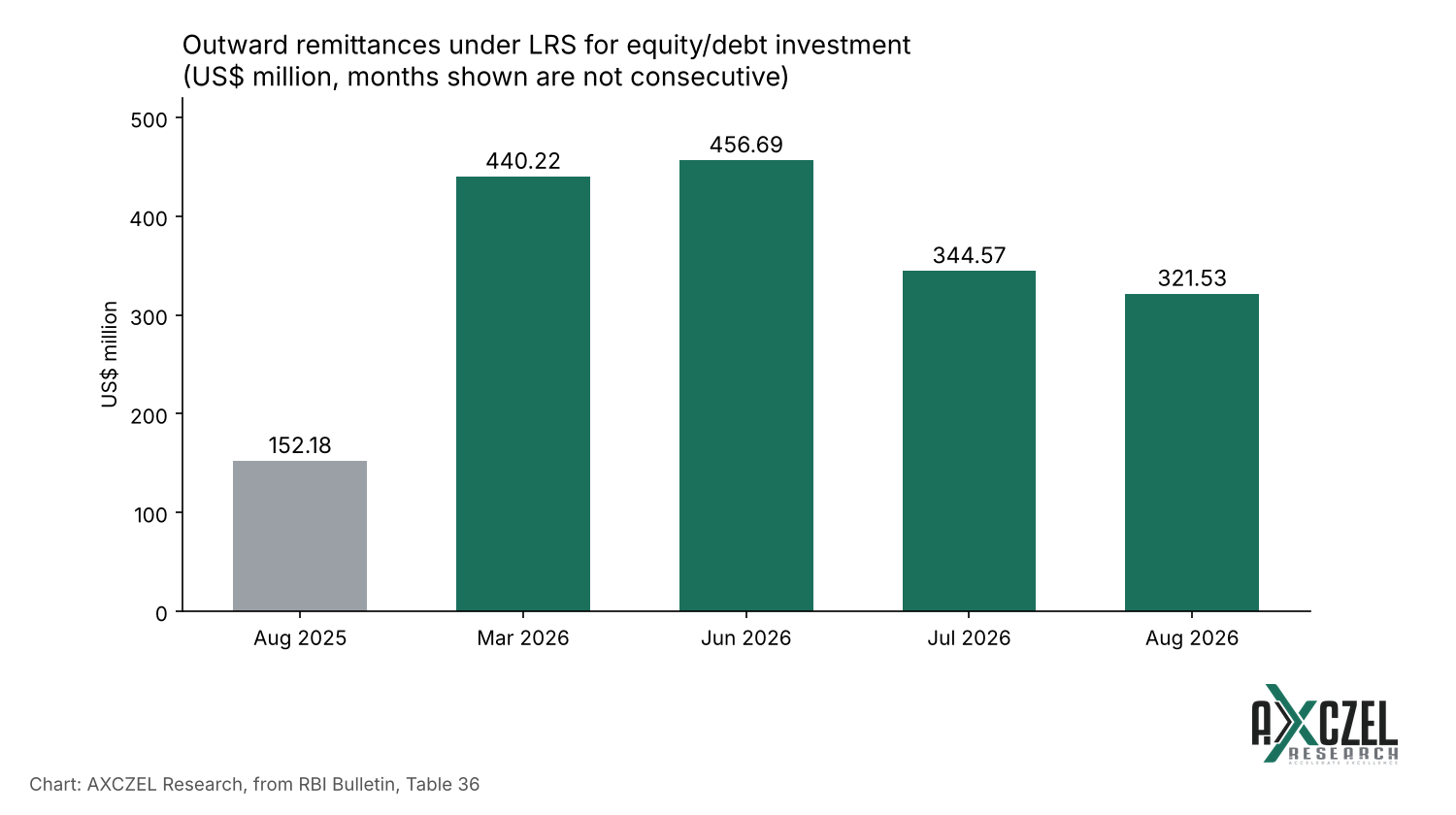
This line covers all foreign equity and debt, not US stocks alone. The other months in the chart (March, June and July 2026) are not consecutive, so please do not read it as a monthly trend. If you want to see how the rupee side of the picture looks, we have an earlier article on RBI rupee measures, and another on why US bond yields matter to Indian stocks.
This article is for information only. It is not investment advice or a recommendation to buy or sell anything, or to use any broker or platform named here. Rules, limits and broker offerings can change, so please check the latest from RBI, IFSCA and your broker. Investments in securities are subject to market risks. Any mistakes in summarising are mine.
Key takeaways
- Who can invest: Resident individuals, minors included, can send up to US$250,000 a year under LRS, with a PAN.
- How: Through an Indian broker’s GIFT City route, a foreign broker account, or Indian funds that invest abroad.
- Brokers: Upstox, Zerodha, Angel One, Groww and Dhan have started or are rolling out; Kotak Neo and ICICI Direct use Interactive Brokers.
- Tax: TCS applies only above ₹10 lakh a year, and foreign holdings go in Schedule FA.
- What the data cannot show: The RBI line is all equity and debt abroad, not US stocks alone.
Frequently asked questions
Yes. Resident individuals can, within the LRS limit of US$250,000 per financial year.
You can use an Indian broker that offers a GIFT City route, open an account with a foreign broker, or buy Indian funds that invest abroad. Money goes out under LRS.
Zerodha began a beta rollout in October 2026. Check the Zerodha app for your access.
GIFT City is India’s international financial services centre in Gujarat. IFSCA, the International Financial Services Centres Authority, is the regulator that oversees it. Its Global Access framework is what lets Indian brokers offer foreign stocks to residents.
Minors are covered by LRS, and a parent or guardian signs the form, per the RBI FAQ. Check your broker’s rules on minor accounts.
Not up to ₹10 lakh in a year. Above that, the rate for investing is 20% under section 394.
Yes, if you are a resident, in Schedule FA, for the calendar year.
Sources
Main sources: CNBC, 28 Oct 2026; RBI FAQs on LRS; RBI Bulletin, Table 36; IFSCA Global Access framework (copy); Income-tax Act 2025, section 394; Income tax department guide on Schedule FA, FSI and TR; Income tax department on long-term capital gains.
Other sources: Inc42 on Upstox; Inc42 on Zerodha; CNBC-TV18 via TradingView; Business Today on Dhan; IRS on Form W-8BEN; Groww; Value Research on international funds; Angel One on international fund SIPs; UNI on Angel One; Upstox, INDmoney, Kotak Neo and ICICI Direct pages.
I used Claude, an AI assistant, to rephrase my notes to make it reader friendly.