

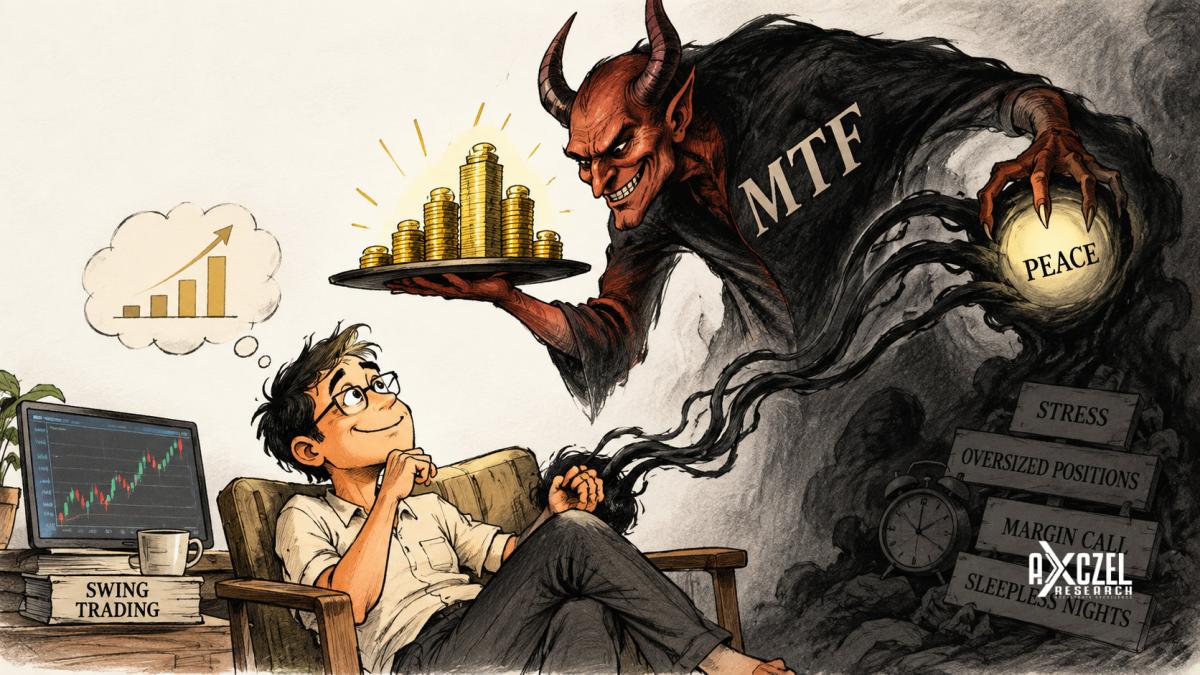
MTF in trading is getting very popular, and I want to check one thing: is it a trap? I am personally against it, and I will tell you why. This is my personal opinion. But first, let us look at the facts.
Where this post comes from: This post started from my own notes on MTF in trading and an explainer on AlgoTest. I then checked the rules against SEBI's text, NSE's own MTF FAQ and an ICRA report. Rates and limits are different at every broker and they change, so please check with your own broker.
What is MTF in trading?
MTF stands for Margin Trading Facility. You buy shares by paying only part of the value. Your broker pays the rest and charges interest on the amount it funded.
If you trade futures or options, this idea is not new to you. You never pay the full value there either. Say a share is ₹1,000 and you buy 25. The full cost is ₹25,000. In derivatives you pay only a part of that. In this post I compare MTF with two things: buying futures and buying call options. I am not covering futures short or call short.
MTF is allowed and regulated by SEBI and the stock exchanges. Not every broker can offer it. Only corporate brokers with a net worth of at least ₹3 crore can, and they need the exchange’s approval first. In June 2026, SEBI proposed raising this to ₹5 crore. As far as I could find, that is still a proposal and not a final rule.
You also cannot use MTF on any stock. Only equity shares and equity ETFs classified as Group I securities are allowed. Group I is a liquidity test. A stock must have traded on at least 80% of days in the last six months, and its impact cost must be 1% or less. Impact cost tells you how much the price moves when you place an order. NSE updates the groups every month. Market capitalization and index membership are not the test, according to AlgoTest. SEBI has also said it is reviewing the group classification. Your broker may offer an even smaller list than Group I.
The shares you buy are pledged. NSE says the funded shares must be held only by way of pledge, in a separate demat account. They cannot be pledged to any other bank or NBFC, and they cannot be mixed with the other collateral you give.
How much do you pay, and what does it cost?
There is no single margin percentage. SEBI lays down the formula by type of stock, and the exchange’s cash-market numbers for each stock go into it. For Group I stocks that trade in F&O, the initial margin is VaR plus 3 times ELM. For other Group I stocks and equity ETFs, it is VaR plus 5 times ELM.
VaR (Value at Risk) is the exchange’s estimate of the most a stock can lose in one day, with 99% confidence. ELM (Extreme Loss Margin) covers losses beyond what VaR covers, and the exchange sets it for each stock. NSE gives an example. With a VaR of 12.5% and an ELM of 5%, the margin for an F&O stock is 27.5%. Your broker can ask for more than this. NSE says the broker must collect the higher of the MTF margin or the 20% minimum of the cash segment, so MTF can never go beyond 5X. For many stocks the margin is higher, so the leverage is lower.
Now interest. This is the main cost. Brokers that quote a daily rate publish anything from about 0.0265% to 0.045% a day. Across brokers, the published yearly rates run from roughly 8% to 16.5% a year, depending on the plan and the amount. For my example below I use 0.04% a day, which works out to about 14.6% a year. A few brokers’ own pages even disagree with each other, so please check the latest rate with your broker. The same comparison shows that most brokers charge ₹15 to ₹20 plus GST each time you pledge or unpledge. Some charge less or more, and some count it per stock, per order or per day. Brokerage is extra. So look at the total cost, not only the interest.
Let me use my ₹25,000 example with a 25% margin and 0.04% a day. You put in ₹6,250 and the broker funds ₹18,750. Interest is ₹7.50 a day, so about ₹225 for 30 days. I am leaving out brokerage and other charges.
| Stock after 30 days | With MTF (your money: ₹6,250) | Without MTF (your money: ₹25,000) |
|---|---|---|
| Flat | −₹225 (−3.6%) | ₹0 |
| Up 10% | +₹2,275 (+36%) | +₹2,500 (+10%) |
| Down 10% | −₹2,725 (−44%) | −₹2,500 (−10%) |
Look at the first row. The stock did nothing and you still lost 3.6% of your own money in a month. The stock has to rise about 0.9% just to cover the interest. Leverage works both ways.
MTF vs buying futures and call options
When you buy a call option, you pay only the premium. There is no SPAN or exposure margin for option buyers, because the most you can lose is the premium. That holds for index options, which are cash settled. Stock options are different near expiry. They end in physical delivery, so brokers ask for extra margin on a long in-the-money stock option in the last few days before expiry. If you hold it to expiry, you have to take or give delivery of the shares.
Futures are different. You pay SPAN margin plus exposure margin. For index futures, the exposure margin is 3% of the contract value. The SPAN part for Nifty futures is typically 5% to 10% and it changes every day. So the total is roughly 8% to 13%, which is about 8 to 12 times leverage. MTF gives at most 5X.
| Call option buy | Futures buy | MTF share buy | |
|---|---|---|---|
| What you pay upfront | Premium only | SPAN + exposure margin, roughly 8% to 13% of contract value | At least 20% of the value, so 5X at most. NSE’s example above is 27.5% |
| Worst case | For index options, you lose the premium, not more. A long in-the-money stock option near expiry needs extra margin and ends in delivery | Profit and loss are settled every day, so a loss can be bigger than your margin | You keep paying margin as the price falls. In a fast fall, the loss can be bigger than the money you put in |
| What works against you | Time and expiry | Daily settlement and expiry | Interest every day. No expiry |
So MTF is milder than futures. It is not a trap just because of how it is built. But there are two things to note. The interest meter runs every day. And unlike an index option buyer, you can lose more than you put in.
What is a margin call, and what happens in a fall?
A margin call is a message from your broker saying your margin has fallen below the level it needs. You must add money or securities. Under NSE’s rules, if the market value of a funded stock falls below the price you bought it at, the broker must collect the difference from you. NSE’s example: you buy at ₹100, it closes at ₹90, and you must put in ₹10 more per share. SEBI also says the collateral and the funded shares are marked to market every day.
If you do not meet the margin call, the broker can sell your shares. NSE says the broker may sell, and the time given is not more than 5 working days from the call. SEBI’s text is stronger and says the broker shall liquidate. Your broker’s terms will list the exact situations, so please read them before your first trade.
Now think of a sudden market crash. Markets can fall even when the economy looks fine, and we have an earlier article on why the Indian stock market was falling despite strong GDP growth. Most stocks fall together, so many margin calls come together, and forced selling can push prices down even more. Also, SEBI’s Investor Protection Fund does not cover losses from MTF.
MTF in trading is growing fast, and small stocks are a big part of it
ICRA says the industry’s MTF exposure hit about ₹1.31 lakh crore on 31 May 2026. That is more than 40 times the March 2020 level, while the Nifty 50 grew about 3 times in the same time. ICRA also says part of the recent growth is only on paper, because several brokers moved to gross reporting from 1 October 2025. It adds that even after adjusting for this, the underlying growth has remained strong. Trackers that use NSE and BSE data show about ₹1.54 lakh crore on 22 October 2026. Different sources count on different dates and in different ways, so the numbers do not match exactly. The direction is clear.
It is not only your risk. Brokers borrow mostly through commercial paper. ICRA says it is over 85% of the borrowings of the top 15 players, and about 76% of it is short term, under about 91 days. SEBI started its June 2026 review because of growing MTF volumes, and took public comments till 9 July 2026.
Even a large broker is careful about it. In its August 2026 business update, Zerodha’s founder Nithin Kamath wrote that “MTF is one area where the business growth is scaring me.” The same update says MTF is about 10% of Zerodha’s revenue, and that he does not think MTF is a good product for most customers. Outlook Money reported the same.
Now look at what people buy. One tracker built on NSE data says small caps were about 49% of the MTF book on 22 October 2026, against about 20% of the market’s value. Small stocks can fall hard. In the week ending 23 October 2026, the Nifty Smallcap 100 fell over 7%, its worst week since February 2025. I could not find data that tells how much of that fall came from margin selling, so I am not claiming it. If you want to follow what big investors are doing, we also have an article on how to track bulk and block deals.
So, is MTF in trading a trap? My view
By law, no. MTF is regulated and the rules are clear. Some people like it for swing trading, because it is quick and flexible, and you pay interest only for the days you hold. I saw this point in Shariq’s video on MTF. It is a fair point. But leverage is a double-edged sword.
Here is some data to keep in mind. SEBI’s latest study, released in August 2026, looks at F&O traders in FY25 and FY26. Among traders who lost money in each of the two years before, 90% to 92% lost money again the next year. Among traders who stayed active in every year from FY22 to FY26, 65.6% lost money in all five years. An earlier SEBI study found that 91% of individual traders lost money in FY25, with a total net loss of ₹1,05,603 crore. That is F&O data, not MTF. I could not find a similar study on MTF clients, so I cannot tell you how many MTF users lose.
In my view, traders lose money mainly because of greed and fear. Now imagine a trade going against you with borrowed money. How is that different from a derivative trade? You feel the same fear, and you may get the same panic.
Personally, I like peaceful investing. MTF adds risk. You now need the market in your favour, and quickly, because interest is running. You are competing with the interest, and the market is the market.
Also, a big profit from a small amount is something everyone likes. In my opinion, that is why hero-zero option buying is so famous on expiry day. A sudden jump near expiry, the gamma blast, tempts people. MTF is slower and smaller, 5X at most and not 10X. But the feeling that pulls people in is the same: more profit from less money.
That is what worries me. A lucrative return from a small capital is very attractive, and if a not-so-expert person gets into it, I am worried. There may be experts who use MTF well. But when it comes to investing or swing trading, I believe peace of mind is important. MTF is not a scam, but for swing trading I feel it takes away the peace. Swing trading needs patience, and with MTF the interest meter and the margin call push you to act.
So this is the message I want to give: try MTF only if you are an expert. This is just my personal opinion.
If you are an expert and still want to use MTF, these are the points I would think about:
Interest is added to your cost every day, so the stock has to gain that much before you make anything. In my example it is about 0.9% in a month.
Full leverage leaves no room for a fall. Some extra cash is what helps when a margin call comes.
Your broker’s terms on margin calls and selling decide what happens when the price falls, so they are worth reading before the first trade.
The longer you hold, the more interest you pay. At 0.04% a day, it works out to about 14.6% a year. So holding longer makes sense only if you have a clear reason and facts to support it, not hope.
Each broker shows funded positions in its own way, so find that screen before you trade.
What about other countries?
“MTF” is the name used in India. Elsewhere the same idea is called margin trading, a margin loan or a margin account.
| India | United States | United Kingdom | |
|---|---|---|---|
| Regulator | SEBI and the exchanges | Federal Reserve (Reg T) and FINRA | FCA |
| Rule | VaR + 3 ELM or VaR + 5 ELM, by stock. At least 20% margin | 50% initial margin and 25% maintenance margin | Traditional retail brokers such as Hargreaves Lansdown and AJ Bell do not offer margin loans. Leverage is available through CFDs, limited by the FCA to 30:1 down to 2:1 |
In the US, a 50% initial margin means you can borrow up to half, which is 2X for a standard margin account. Some account types follow different rules. India allows up to 5X. Interest differs too, and not only by country. As of 21 September 2026, Interactive Brokers shows 5.38% on a USD 25,000 loan, while Schwab shows 11.58%. These are dollar rates and India’s are rupee rates, so they are not a direct comparison. Interactive Brokers publishes that table itself, so take it as an example, not as the market average.
This post is for information only and is not investment advice. It is my personal opinion. Rules, rates and limits can change, and some of the figures here come from broker pages and trackers that may be updated. If I have made a mistake while summarizing, it is mine.
Key takeaways
- What it is: MTF lets you buy shares by paying only part of the value. The broker funds the rest and charges interest on it.
- How it is controlled: SEBI and the exchanges regulate it. Only Group I stocks and equity ETFs are allowed, the margin is at least 20%, and the shares are pledged.
- What it costs: Published rates run from roughly 8% to 16.5% a year. At 0.04% a day, which is about 14.6% a year, the stock in my example must rise about 0.9% in a month just to cover the interest.
- The main risk: A margin call can force you to sell, and unlike an index call option buyer, your loss is not limited to what you put in.
- My view: MTF is not a scam, but I feel it takes the peace out of swing trading. Try it only if you are an expert.
Frequently asked questions
MTF means Margin Trading Facility. You pay part of the share price and your broker funds the rest, and charges interest on the funded amount.
It is regulated by SEBI and the exchanges, but regulated does not mean risk-free. Leverage works both ways, and if you do not meet a margin call the broker can sell your shares. NSE’s FAQ gives not more than 5 working days from the call for that.
It depends on the broker and the plan. Published rates run from roughly 8% to 16.5% a year, and daily rates run from about 0.0265% to 0.045%. Check the pledge fees and brokerage too, not just the interest.
You have to pay the fall as margin. NSE’s example: a stock bought at ₹100 that closes at ₹90 means ₹10 more margin per share. If you do not pay, the broker can sell your shares.
Only Group I equity shares and equity ETFs. NSE updates the groups every month, and your broker may allow fewer stocks.
In my personal opinion, only experts. MTF gives at most 5X, and futures give roughly 8 to 12 times based on the margin figures above. But an index call option buyer can lose only the premium, and an MTF buyer can lose more than they put in.
Sources
Main sources
SEBI, Master Circular text on margin trading (hosted on sebi.gov.in)
NSE, FAQs on Margin Trading Facility
NSE, Categorisation of stocks for imposition of margins
ICRA, ICRA’s View on Margin Trading Facility, June 2026
SEBI, Consultation Paper on Review of Margin Trading Facility Framework, 18 June 2026
Business Standard, Sebi seeks to tighten MTF rules with new exposure, funding norms
Other sources
Business Standard, Sebi proposes stricter MTF norms, wider funding options for brokers
Zerodha, 16 years of Zerodha: Fresh enthusiasm (business update, 26 August 2026)
Outlook Money, Nithin Kamath on MTF growth
Outlook Money, Sebi study on F&O traders, losses and experience
Business Standard, Net losses of individual traders in F&O widened in FY25: Sebi study
Groww, Understanding the concept of margins in the cash market
OneTradeJournal, MTF interest rates compared (data checked 14 October 2026)
mtf.trading, India MTF book tracker (NSE and BSE disclosures)
tipsheet.markets, Margin trading (MTF) in detail (built on NSE data)
HDFC Sky, The Prime Weekly, 26 October 2026
NSE, Equity derivatives margins
Geojit, Why margins are asked when you buy stock options
Zerodha, Policy on physical settlement of equity derivatives
Interactive Brokers, US margin loan rates comparison
BrokerChooser, Leverage and margin limits in the UK
YouTube, Shariq’s video on MTF for swing trades
I used Claude, an AI assistant, to rephrase my notes to make it reader friendly.